Presented at Bizz & Buzz, Strasbourg, on 15 October 2026.
Interactive study
Tell the study who you are. It tells you what to watch first.
The findings below are the same for everyone. What matters in them is not. A cookware brand selling in France and Germany does not need the same priorities as a Swiss industrial manufacturer whose site exists in German only. The interactive study asks three questions, then reorders the seven findings and the seven recommendations around your answers.
How it works
- Tick where you sellFrance, Germany, Switzerland
- Tick the languages your site exists inFrench, German, English
- Say what you sellTo businesses (B2B) or to consumers (B2C)
Your three points to watch appear at once. The sorting runs in your browser: nothing is sent.
Open to everyone
- The seven findings, each with its chart, its base and its caveat
- The five hypotheses, including the two that fail
- The method and its limits
With your email
- The most-cited sites by tool, language and country
- Two set-ups side by side
- 70 manufacturers, named and linked
- The recommendations in full
- The full report (93 pages) and the summary (19 pages)
1,510 answers analysed and 12,414 links cited. Collected 25 September to 2 October 2026, logged out, with a VPN set to Paris, Frankfurt and Zurich.
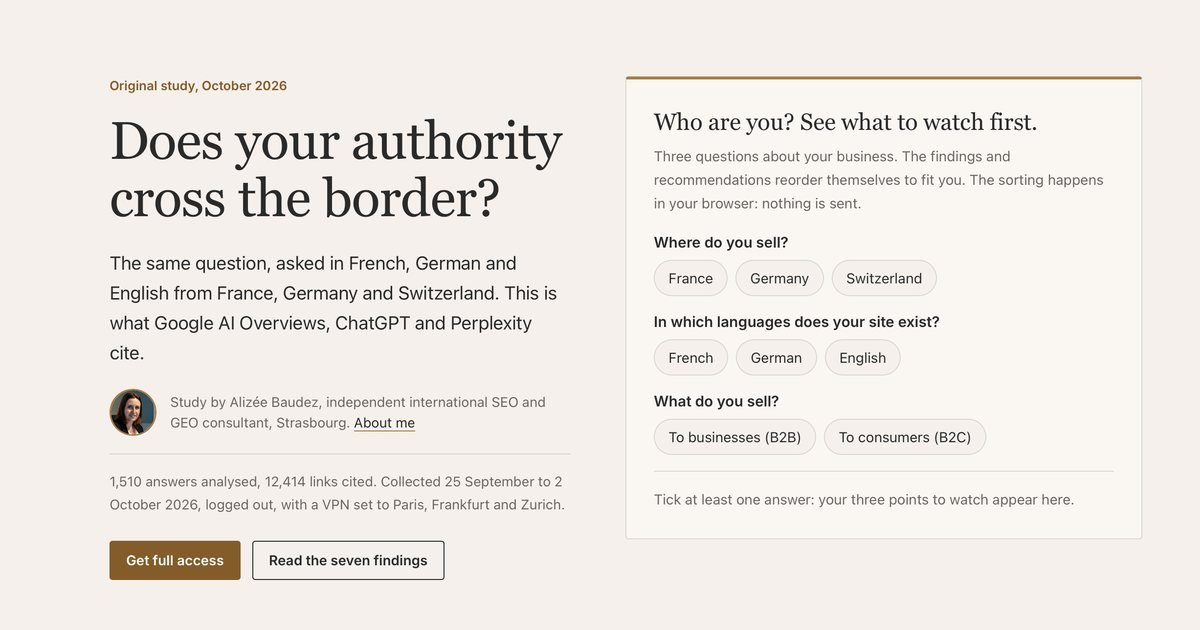
The same question, asked in French, German and English from Paris, Frankfurt and Zurich, to Google, ChatGPT and Perplexity. For two of the three tools, changing country barely changes the sources they cite. Changing language changes almost all of them.
Five identical sources, then none
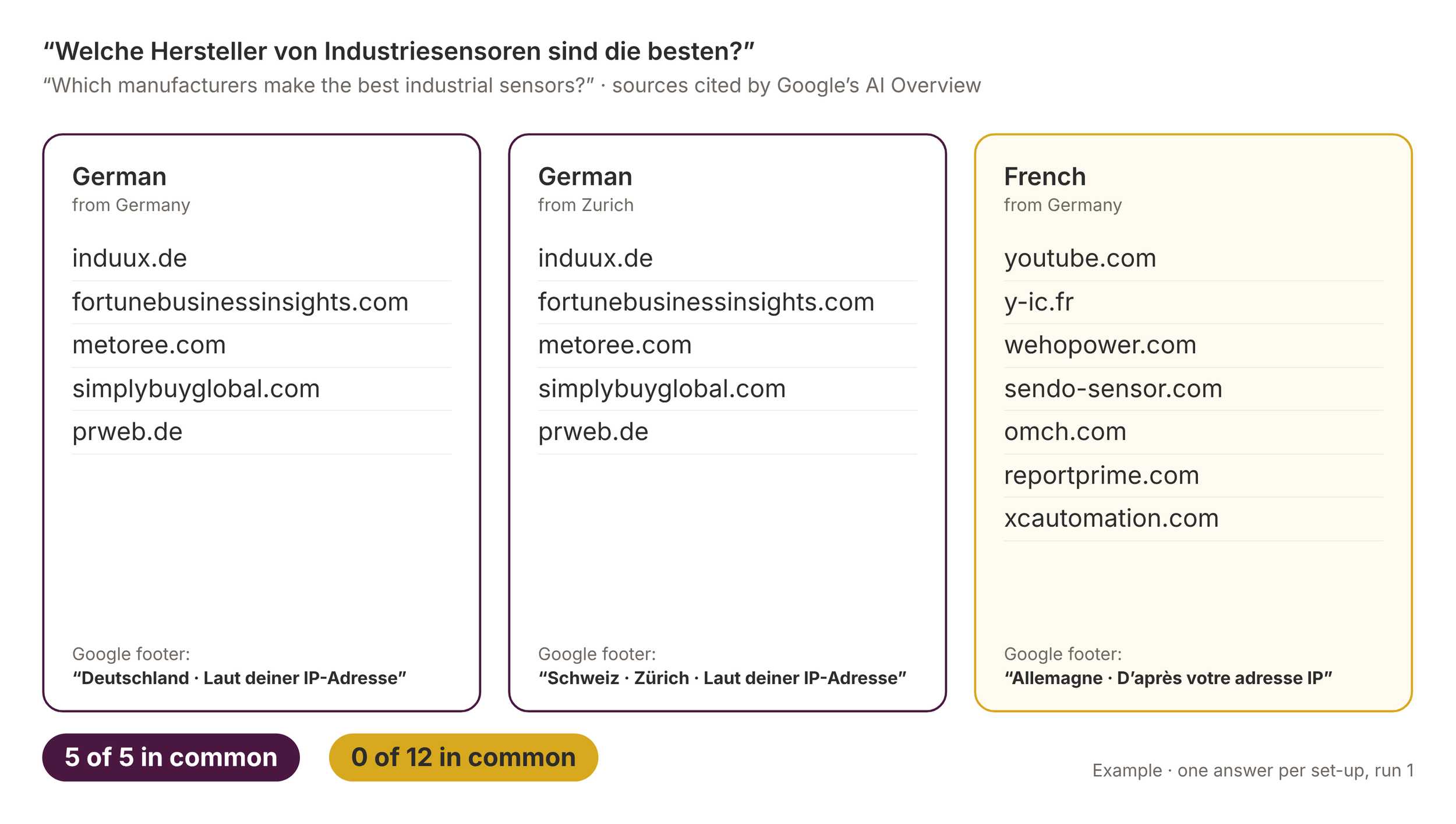
I asked Google, in German, who makes the best industrial sensors. Once from Germany, once from Zurich. Google knows where I am: it says so at the bottom of the page. Its AI Overview still cites exactly the same five sources in both countries.
Then I asked the same question in French, still from Germany. Seven sources came back, none of them among the previous five. Of the twelve sites cited across the three answers, not one appears in both the German and the French set.
One answer is not a trend, and this one stays an example. It still frames the question of the whole study: when a brand sells in France, Germany and Switzerland, does its authority in the eyes of AI tools cross the border with it?
Why this study, and why here
Google's AI Overviews and AI Mode reached France on 22 July 2026. Companies in our region, in Alsace, Baden-Württemberg or Switzerland, rarely sell in one country and one language. For them the question is practical: does what AI tools say about us in France also hold in Germany and Switzerland, and in which language?
I work on international SEO and AI visibility across French-, English- and German-speaking markets. My starting intuition fitted in one sentence: a brand's authority does not cross a border on its own. The study was built to confirm that, or to contradict it.
The set-up: three countries, three languages
Each question is asked in nine configurations: three languages (French, German, English) from three countries (France, Germany, Switzerland).
| Language of the question | From France VPN Paris | From Germany VPN Frankfurt | From Switzerland VPN Zurich |
|---|---|---|---|
| French | 216 test runs | 216 test runs | 216 test runs |
| German | 216 test runs | 216 test runs | 216 test runs |
| English control | 216 test runs | 216 test runs | 216 test runs |
The grid reads both ways. A row is the same language in three countries, so it shows what location changes. A column is the same country in three languages, so it shows what language changes. English is the control: it is the home language of none of the three countries, so a question in English says nothing about where you are.
Three tools: Google's AI Overviews, ChatGPT and Perplexity.
Two sectors: cookware for e-commerce, and electrical components and automation for industrial B2B. Brands from our region, such as Staub and Socomec, sit beside Le Creuset, Schneider Electric and Endress+Hauser.
24 questions, twelve per sector, from the first problem to the purchase. Each is written directly in each language rather than translated word for word, then sent unchanged from all three countries: no currency, no country named. The question design follows the method of Luca Fancello (Qwairy).
1,944 test runs planned: 648 tests (24 questions × 9 set-ups × 3 tools), each run three times, logged out, in a fresh private session, with a VPN set to Paris, Frankfurt or Zurich. A script collected them overnight, from 25 September to 2 October 2026.
A source is "stable" when it comes back in at least two of the three runs. The Google and ChatGPT figures rest on stable sources. Perplexity refused many logged-out visitors, so it ran once per test and its figures cover all its citations.
In all, the analysis covers 1,510 answers (648 Google searches, 406 of them with an AI Overview, 647 ChatGPT answers and 215 Perplexity answers) and 12,414 cited links.
Finding 1 · Language is the border that counts
To compare two answers, I measure the share of cited sites they have in common. The benchmark is the same test repeated a few hours later: no AI tool answers twice in exactly the same way, and this figure sets the normal level of variation.
| Tool | Same test, repeated benchmark | Same language, other country | Same country, other language |
|---|---|---|---|
| Google AI Overviews | 45 % | 32 % | 8 % |
| Perplexity | 79 % | 75 % | 5 % |
| ChatGPT | 51 % | 39 % | 38 % |
On Google, two answers in the same language from two countries share 32% of their sources. From the same country in two languages, they share 8%. On Perplexity the gap is sharper. Moving the VPN from Paris to Frankfurt or Zurich changes almost nothing, because the answers stay as close as two runs of the same test. Changing language replaces almost every source.
English takes the logic to its end. A question in English brings up international sources in all three countries, Zurich included: 81 to 84% of Google's stable citations and 76 to 79% of Perplexity's, in English answers from each country.
My starting thesis comes out sharper rather than confirmed. Authority travels from one country to another as long as the language stays the same. The language border is the one it does not cross.
For a company that sells on both sides of the Rhine, the consequence is concrete. For these tools, your German site is not a translation of your French one. It is your presence on another market, facing other sources and often other competitors. Before touching a site, look at who gets cited in each language.
Finding 2 · ChatGPT reads your IP address
ChatGPT is the exception. It is the only one of the three whose sources change as much with the country as with the language (39% against 38% in the table above).
Three questions in the study depend on the country of the person asking: which shop to order cookware from, which automation supplier to choose, which legal obligations apply to measuring energy at an industrial site. On these three, ChatGPT treats your IP address as your home country in 52 of 81 answers. Google does so in 19 of 67, Perplexity in 5 of 27.
Even in English, ChatGPT keeps sources from the country you connect from: 26.7% of its citations, against 6.4% for Google and 2.1% for Perplexity (all citations in English answers). Across all languages, sites from the tested country make up 33.2% of ChatGPT's stable citations (328), against 18.1% for Google (708) and 18.8% for Perplexity (1,774 citations).
Two answers from Zurich show the difference. On the energy-measurement obligations, ChatGPT, asked in English, begins by saying that everything depends on the country and, in Switzerland, on the canton. It then sets out the Swiss rules. Google, asked in German from the same place, answers with German law, although the same page says at the bottom that my IP address is in Switzerland. For Google, Zurich speaks German. For ChatGPT, Zurich is in Switzerland.
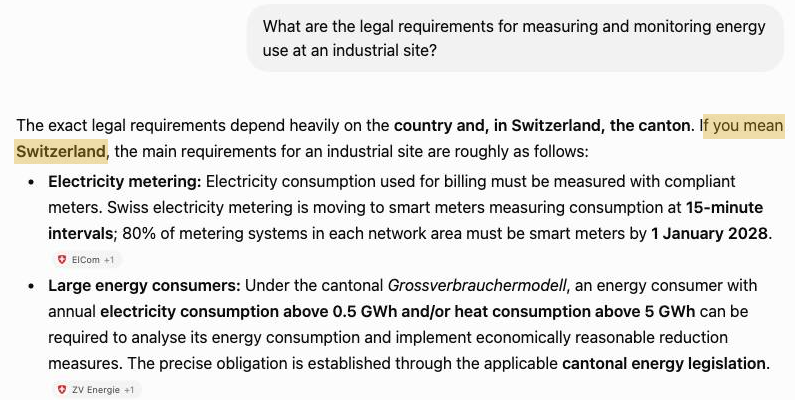
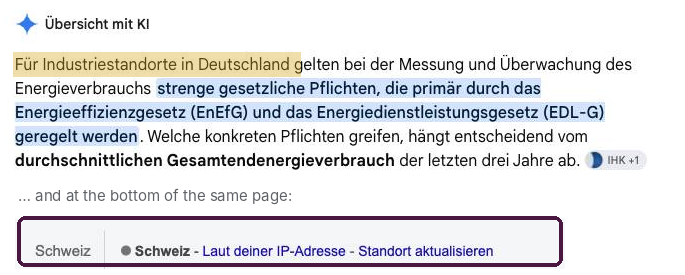
Examples: ChatGPT, test CH-EA03-en, run 2; Google AI Overviews, test CH-EA03-de, run 1.
So there is not one AI visibility but at least three, each with its own logic: Google and Perplexity read the language, ChatGPT reads the country. A single score that blends them hides what matters. Measuring your visibility means asking the same questions on each tool, in each language, from each country, and more than once. On Google, the same test repeated keeps only 45% of its sources.
One proportion to keep. ChatGPT is not an acquisition channel today. It is a step in the buying journey, a place where people form an idea before checking elsewhere. Most conversions still happen in Google, and AI built into Google is the larger part of the shift.
Finding 3 · From Switzerland, AI tools cite your neighbours
Switzerland has no language of its own. From Zurich, a question in French brings up more French sites than Swiss ones, and a question in German more German sites than Swiss ones.
| Tool | Question in French French sites / Swiss sites | Question in German German sites / Swiss sites |
|---|---|---|
| Google AI Overviews stable citations | 32.2 % neighbour21.1 % Swiss90 citations | 40.5 % neighbour15.5 % Swiss84 citations |
| Perplexity all citations | 59.0 % neighbour9.5 % Swiss210 citations | 75.3 % neighbour5.6 % Swiss198 citations |
For ChatGPT, the results are mixed and rest on small bases (34 stable citations per language), so I do not count them as a result.
One example makes it concrete. From Zurich, in French, on the energy-measurement obligations, Perplexity cites thirteen sites. Twelve are French, none is Swiss, and the answer opens by describing an industrial site "in France". For a company in French-speaking Switzerland, that is simply the wrong regulation.
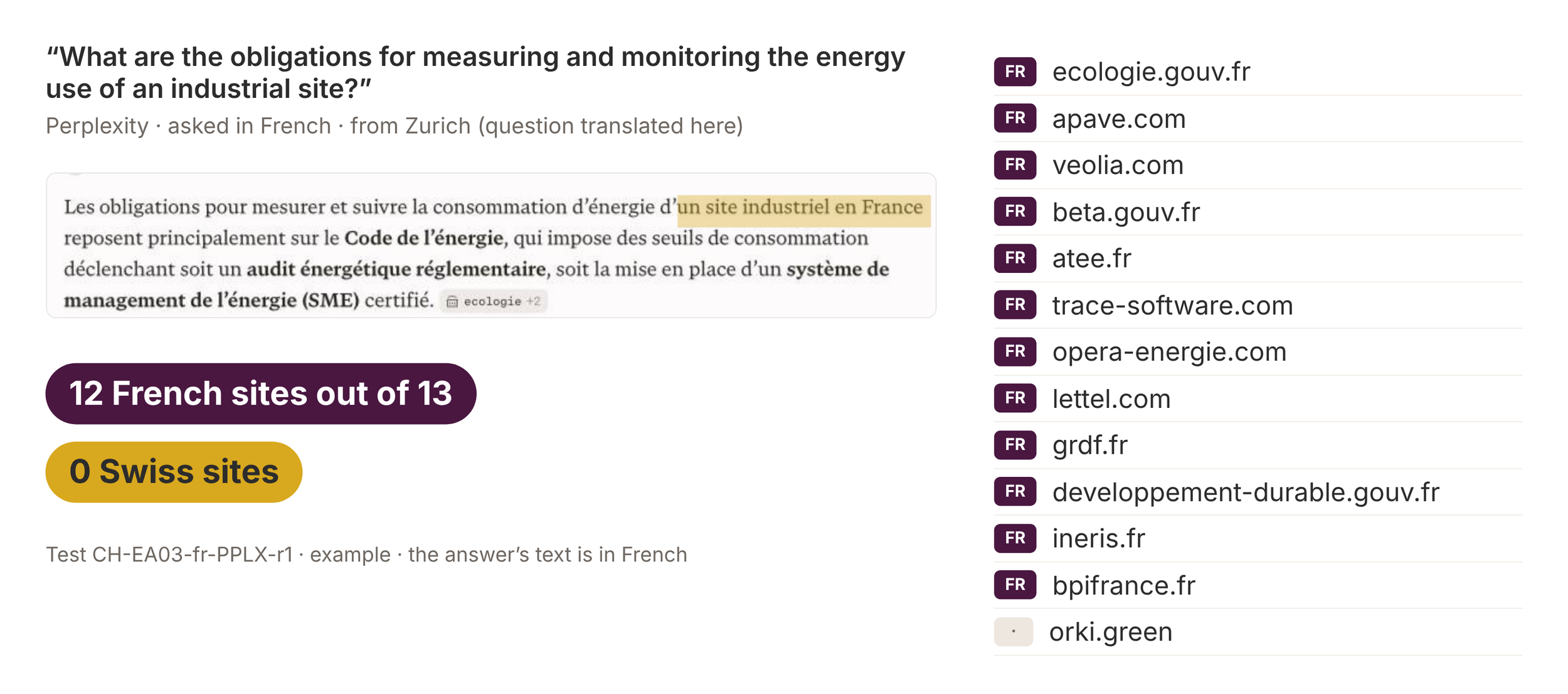
Selling in Switzerland therefore means competing with France and Germany. Your French page is not compared with other Swiss sites but with all French ones. Your German page is compared with all German ones. This is where localisation pays: a page written for French-speaking Switzerland, with Swiss references, Swiss standards, prices in francs and local distributors, offers something no French site can. That is a practitioner's recommendation, which the study does not measure directly.
Four more results in the full study
These three findings are the ones I presented on stage. Four more sit in the interactive study, each with its base and its caveat.
In B2B, the manufacturer's own site is the first source. It makes up 78.8% of ChatGPT's stable B2B citations (189), 46.2% of Google's (366) and 51.2% of Perplexity's citations (869). In cookware the same share falls to 20.9% (139), 19.0% (342) and 9.5% (905), and media, comparison sites, forums and video carry the answers. This one is specific to the sector.
In cookware, the AI Overview steps back as the buyer nears the purchase. It appears for 90.7% of the problem searches ("my pans keep sticking") and for 1 of 27 "where to buy" searches. The purchase stage is a single question, so read it as one question, not as a stage. Also specific to a sector.
ChatGPT cites language folders on a global domain. 67.1% of its 1,929 brand-site links sit in folders such as se.com/fr/, against 38.1% of the brand pages in Google's top 10 (1,792 links). It rests on 40 domains, six of which carry 65% of the folder links, so it describes large global brands more than a rule.
Brands are named in their own language. The share of French brands among the manufacturers named rises from 21.9% to 34.1% when the question is asked in French, and that of German brands from 35.1% to 50.4% when it is asked in German (2,012 mentions in answers to the 16 questions that name no brand, three tools together). The effect is clearer in B2B.
Two hypotheses the data knocked down
I started with five hypotheses, written before the collection. Three hold, in whole or in part. Two fell.
"Google's AI will be the most local." No: ChatGPT is. Sites from the tested country make up 33.2% of its stable citations, against 18.1% for Google.
"Big brands get cited with a link, regional champions are only named." No: both are mostly named without a link. 27.4% of the mentions of giants come with a link to their site, against 25.8% for champions (826 and 1,877 mentions; each brand is sized on its own revenue, and a champion has revenue under €5 billion).
What the study does not say
This study is a photograph, not a film. It describes what AI tools did during one week at the end of September 2026, not what they will always do.
Logged out: someone signed in, with a history, may get other answers.
One VPN city per country: Zurich stands for all of Switzerland.
The same question text in every country, with no currency and no country named.
24 questions in two sectors: the "learn" and "buy" stages rest on a single question per sector.
Perplexity ran once per question, and it refused nearly half of the logged-out requests.
Each country was collected on a different day, so part of the "country" effect seen on ChatGPT may come from the day. The country the answer assumes is read in the text and is not affected.
The browser language followed the language of the question: "language" means both together.
Collected by script, at a human pace, with no CAPTCHA bypass.
Site types were coded by AI agents and reviewed by me, with no second human coder.
The results describe what the tools cite, not why, and not what would get a site cited. No traffic is measured.
Explore it yourself
The seven findings, the five hypotheses, the method and the limits are open to everyone in the interactive study. Tick where you sell, the languages of your site and what you sell, and the page reorders its findings and recommendations around you. Signing up with your email opens the rest: the most-cited sites by tool, language and country, two set-ups side by side, 70 manufacturers named and linked, the recommendations in full, and the report (93 pages) and summary (19 pages).
Prefer a download? Both PDFs are also on Gumroad, pay what you want: [GUMROAD EN LINK, to add].
And for your brand?
What this study shows across two sectors, I can measure for your brand: in your markets, in your languages, with your customers' questions. That is the Multi-Market AI Visibility Sprint. In one week, you know what AI tools say about your brand in each country and each language, which sources they use, where you exist and where a competitor has taken your place. You leave with a prioritised action plan.
I will not promise you traffic from ChatGPT. The aim is to know where you stand, market by market, and what to start with. Let’s talk about it!
Thank you to Luca Fancello (Qwairy), whose method shaped how the questions were written.