This is the written version of my lightning talk at Google Search Central Live Deep Dive Europe, in Barcelona on 1 October 2026. You can also get the worksheet that walks you through all three signals on your own site.
The worksheet
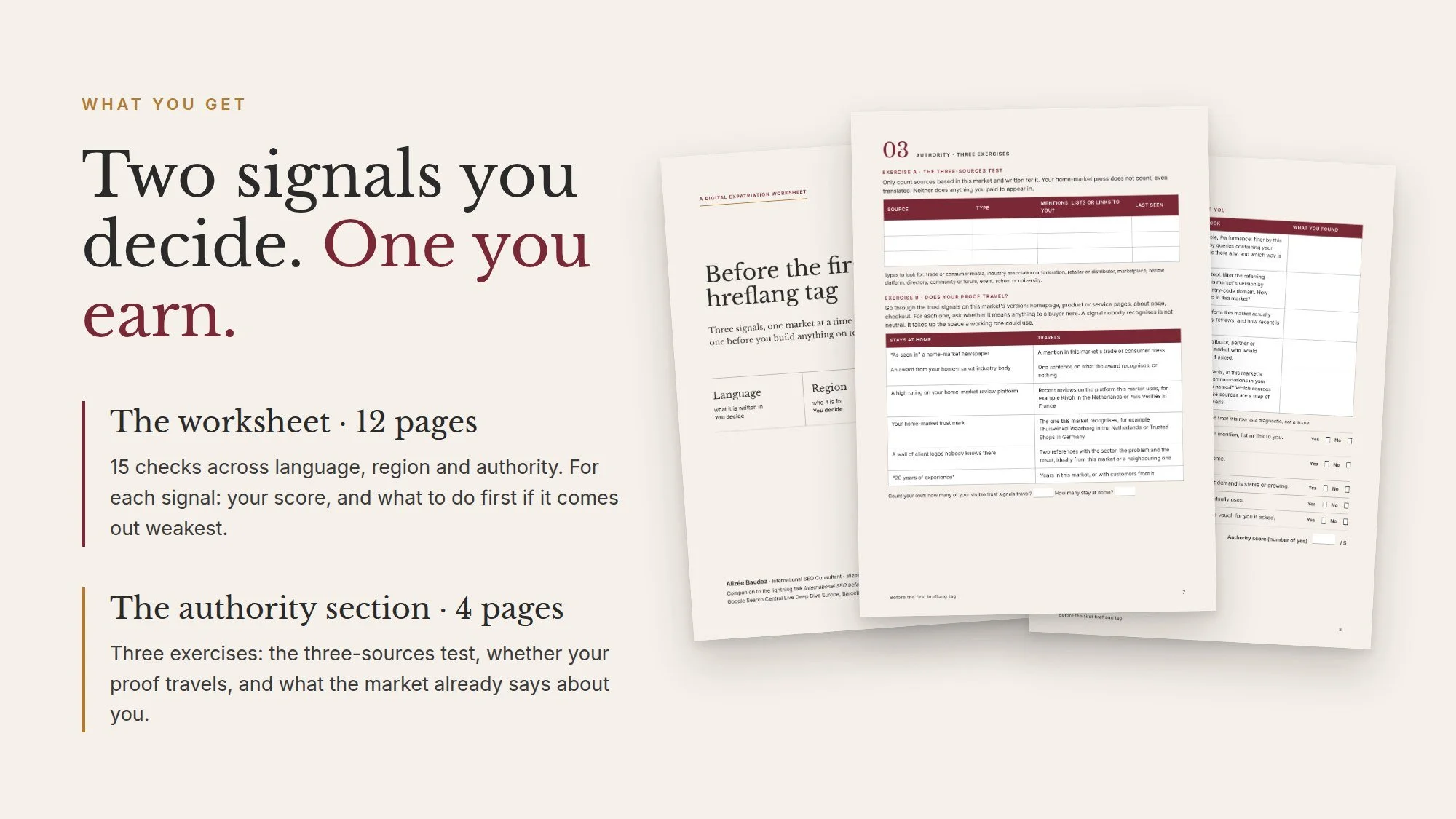
The three questions, as a worksheet you run on your own site, one market at a time. It scores each signal, shows you which one is weakest, and tells you what to do about that one first. The authority section is the longest, for the reasons above.
It is one slice of Digital Expatriation, the framework I use for multi-market search strategy.
A translation with nothing wrong with it
A French furniture manufacturer asked me to audit its multilingual websites ahead of a potential acquisition. They make premium multifunctional furniture. France is the home market, and they sell across Europe.
So I went through every site, and honestly, they had done a good job. Native translators, good content, a decent technical setup. Every site showcased the same products with the same photos. And the Dutch site converted noticeably worse than the rest.
My first instinct was to look at how a major furniture retailer handles the same problem, so I looked at IKEA. Its country sites don't show the same products from one market to the next, and they don't show the same interiors either.
My second instinct was that the Netherlands is small and densely populated, so Dutch homes must be smaller than French ones. That is an instinct, not a strategy, so I checked it. It was wrong. Living space per person is almost identical: 53 m² in the Netherlands (CBS, 2017 figures) against 52 m² in France (INSEE, 2024).


What differs is the shape of the home. In 2019, 58% of the Dutch population lived in a semi-detached or terraced house, against 19% across the EU (Eurostat). Narrow frontage, three floors, and a staircase that is famously not designed for carrying furniture. That is a completely different problem from a wide room on one level, and the Dutch site was still selling to the second one.
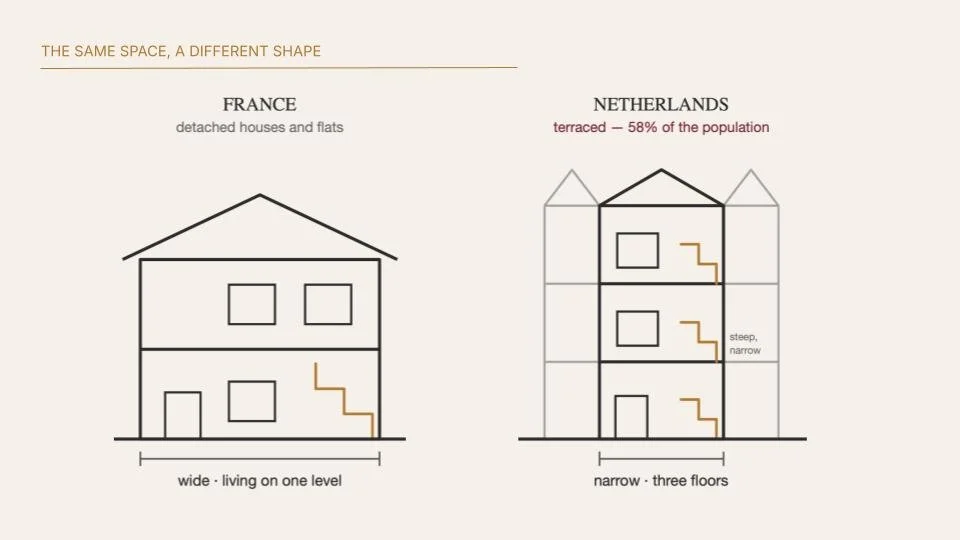
Nothing had been mistranslated. The language was right. The region had never been looked at. So the action plan was about the context the buyers live in, not the words: which products lead in each market, and which rooms they are photographed in. It didn't touch a word of the translation.
There was a second consequence, and it is the one this post is really about. Because the site did not fit Dutch homes, it could not build any authority in the Netherlands either. Nobody links to a shop that does not fit their house. Nobody comes back to it. Nobody in that market has a reason to treat you as real.
Three signals, treated as one decision
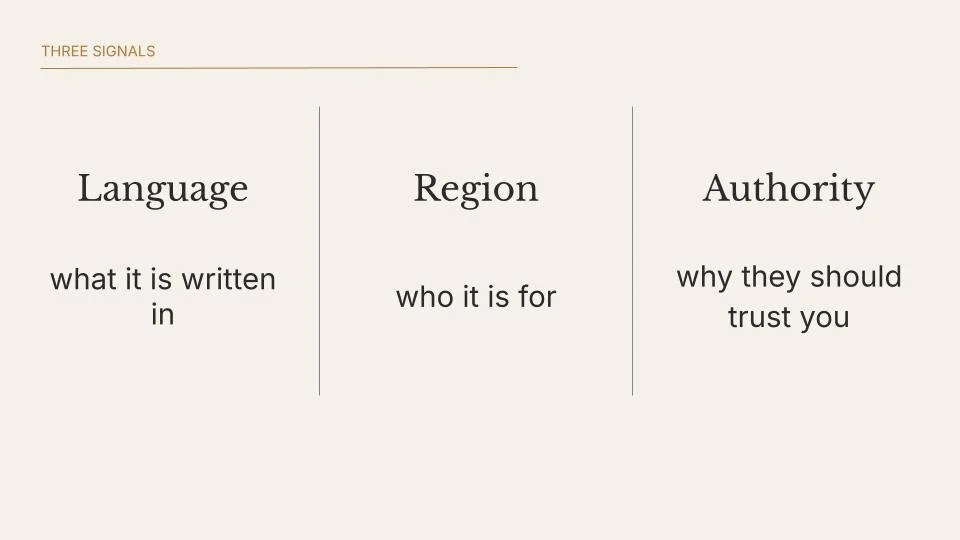
Every international site sends three signals, and most teams settle them as a single decision.
Language is what the content is written in.
Region is who the content is for.
Authority is whether that market has any reason to trust you. Not a toolbar number: actual standing, in that market, judged by that market.
They are not the same kind of thing. Language you decide. Region you decide. Authority you earn, market by market, every time. Two of the three are declarations and the third is an outcome, which is exactly why teams assume the first two confer the third.
They don't. Setting hreflang to de-AT does not make you a thing in Austria.
Hreflang is not the hard part
In 2017, Semrush audited 20,000 multilingual sites and found that 75% had at least one hreflang error. The figure is old, and the pattern has held: an independent 2023 study by Dan Taylor for Search Engine Land found conflicting hreflang directives on 31% of 18,786 international sites, and no x-default on almost half of them.
So the industry has, reasonably enough, decided that hreflang is the hard part. It gets the audits, the validators and the conference slots.
It isn't. Hreflang tells Google which version of a page to show to which user. Google's own documentation frames it as a way to point to localised versions of a page, and Google's search team has repeated for years that it is not a ranking boost. It swaps the right URL into a result the page has already earned. It does not create relevance in a market, and it does not carry trust from one version to another.
You can implement it perfectly on top of three assumptions nobody ever wrote down. The tags will validate. The market will not care.
Language: the decision that usually defaults
The first question sounds too simple to ask. Which language variants do you actually serve?
Most sites never answer it. They inherit an answer from the CMS or the translation plugin, and the answer is one version per language. German means one German. French means one French. That is a decision, even if nobody made it.
Sometimes it is the right one. Often it has simply never been examined. Swiss Standard German does not use the ß. Belgian and Swiss French say septante and nonante where France says soixante-dix and quatre-vingt-dix. Neither detail breaks a page on its own. Both tell a reader, in the first paragraph, whether the page was written for them or forwarded to them.
The other half of the language question is coverage. A translation workflow translates what it can see, and it cannot see much.
I bought a travel cot from a Dutch family business through its French storefront. The page text was in French. Around it, the delivery countdown still spoke Dutch, some product images carried Dutch text baked into the pixels, and the structured data description was in English on every locale. A product description badly translated nearly lost them my purchase!
None of it was visible to the translation tool, because none of it was page text. All of it was visible to me. The structured data is the quietest of the three, and arguably the one that travels furthest: it is a description written specifically for machines, in a language the market doesn't read.
Region: the question that expires
The second question: for each language variant, what genuinely differs between the regions it serves?
Catalogue, price and payment, delivery, legal constraints, seasonality, and what physically fits in the room. Payment is a useful first test because it is so concrete. A Dutch checkout without iDEAL, a Belgian one without Bancontact or a Swiss one without TWINT tells the buyer the same thing the staircase told my client's Dutch customers: this was not built for you.
The method matters more than the list. Look at how someone who has already solved the problem does it. Form an instinct about why. Name it as an instinct, then check it against proper data before it goes anywhere near an action plan. In the audit, IKEA told me where to look. My instinct about Dutch homes was wrong, and checking it is what surfaced the answer that mattered.
Region also has its own geography, and it is not the geography of language. Five years of Google Trends data for ceiling fans shows steady summer peaks in Spain, Greece and Italy, and a much flatter line across Belgium, Germany, Denmark, France, the UK and the Netherlands. Until the summer of 2026, when the northern peak caught up with the southern one and briefly overtook it.
A Spanish brand assessing northern Europe five years ago would have concluded that the north does not buy ceiling fans. It would have been right. It would be wrong now.
So the answers expire. Region is not a language, and it is not permanent. Every answer you write down needs a date next to it, and a date to check it again.
Authority: the one you can't declare
The third question is the one teams skip, and the one the other two quietly depend on. For each region, can you name three local sources that already treat you as present there?
Authority here does not mean Domain Authority or any other third-party score. It means standing inside one market's own information environment: the publications that mention you, the partners and associations that list you, the reviews on the platform locals actually use, the people who search for you by name. Search engines infer that you are a real actor in a market from signals like these. They cannot infer it from your hreflang.
This is why authority does not travel the way content does. You can copy a page into a new subfolder in an afternoon. You cannot copy the fact that French trade media know who you are into the Dutch market. Reputation is built inside an ecosystem, and ecosystems are local. That holds even when everything happens online, and even when everyone speaks the same language.
AI answers make this more visible, not less. A June 2026 study of 128 brands across 12 markets and 13 languages found that 85.7% of the citations AI systems used to describe a brand pointed to sites the brand did not own. The same study found that the mix of cited sources is specific to each market. Its author is affiliated with an AI-visibility vendor, so read it as a strong indication rather than settled science. The direction is hard to argue with all the same. You cannot own your way to local standing.
It also explains the order of operations. When the region is wrong, authority cannot start. The Dutch site had no fit, so it had nobody to earn trust from. Fixing the region would not create authority. It would make authority possible.
The worksheet goes much further on this signal: how to audit it one market at a time, which of your existing trust signals survive the border, and what to do first when it comes out as your weakest.
If you can't answer the third question
This is the rule I closed the talk with. If you cannot name three local sources for a market you already serve, don't open another market. Fix the ones you have.
It sounds conservative. It is the opposite. Two markets with full investment beat ten at surface level, because authority compounds inside a market and does not transfer between them. Every new market you open starts the third signal again from zero.
What the three answers decide
The expensive structural decisions in international SEO come out of these three answers. Made in this order, they stop being expensive.
Your language answer becomes your hreflang set. Which language-region codes exist, whether a regional variant gets its own version or shares one, and where x-default points.
Your region answer decides whether a regional version needs its own content or just its own signals. If nothing genuinely differs between Germany and Austria for your business, a separate de-AT version is a maintenance cost with no upside. If something does differ, a shared version will keep underperforming there, however clean the tags are.
Your authority answer decides where to concentrate. Google's guidance lays out the trade-offs between country-code domains, subdomains and subdirectories, and none of them is a ranking shortcut. What the structure changes is how easily trust consolidates. A market where you have little standing usually gains more from sitting inside a domain that already has some than from starting a new one from nothing.
These are the decisions that turn into migrations when they are made by default. Made after the three questions, they are just decisions.
If you were in the room in Barcelona, I'd love to keep the conversation going. Find me on LinkedIn.