The Verge has been asking "what is a photo?" for about a decade. Every time smartphone manufacturers ship a new computational photography feature (every HDR stack, every night mode, every AI-filled sky), the question shifts a little further from what we thought photography was.
After Google I/O 2026, I've been thinking the same about text.
What Google I/O 2026 showed, more clearly than any previous demo cycle, is text being produced at scale without anyone producing it. AI-written artefacts, generated summaries, prose that answers your query and then disappears, Google Docs Live writing entire documents for you based on a voice note.
Side note: who even uses GDocs for to-do lists? If that's you, please explain why, I'm confused... To me it's probably the most ineffective way to get stuff done. If you're into effective todo lists, check out the end of this email. 👀
These new features prompted a genuine question I haven't been able to shake: what is text, today?
The easy answer is that text has always been two things.
There's text as vehicle: the stuff that carries information from one mind to another, that serves as scaffolding for something else (the presentation, the decision, the meeting).
And there's text as art: the kind that moves people, shifts societies, gets read a hundred years later. The Verge framing applies cleanly here. Computational photography didn't replace portrait photographers. It automated the vehicle and left the art intact.
So the vehicle is getting faster. Fine. Most text was never art. The briefing notes, the website copy, the how-to article nobody reads twice, if AI handles that more efficiently, the world loses nothing it will mourn.
But there's a third category that doesn't fit either, and that's where I keep getting stuck.
Thinking made visible.
Writing is slow. That's not a flaw, it's the mechanism. Your thinking pace is always faster than your writing pace, and that gap is where complexity gets articulated. When you write something out, you find the contradiction in your own argument. You notice that the sentence you were certain about doesn't survive being put into words.
If you keep a journal like I do, you see exactly what I mean.
This process doesn't happen when you speak. It doesn't happen when you think. It happens in the friction between thought and written language.
A lot of what I produce couldn't exist without that friction. Not because the text itself is art, but because the act of writing it is how the thinking got done.
This is what may be quietly at stake. Not the vehicle, not the art. The thinking-writing loop.
If you outsource the writing, do you also outsource the thinking? Not necessarily. You can generate a first draft and engage with it, interrogate it, argue with it, rewrite it until it's yours. Some people work this way well. But the default is faster than that. The default is: generate, review briefly, publish. And in that workflow, the friction disappears. The sentence that wouldn't survive being put into words never gets tested, because it was put into words by something that doesn't have beliefs.
I use AI tools. I'm not making a doomy argument and I'm not going back. But I've become more intentional about when I hand over the keyboard and when I don't. Some things want to be written by me — not because the writing is precious, but because the thinking that comes out of it is.
The practical implication for content strategy is narrower than it sounds. If text-as-information is commoditised, the only defensible work is the kind only you could have produced: the first-hand observation, the specific opinion that comes from specific experience, the case study that finished a strategy. Not as a moral position. As a craft brief.
What is text, anyway? Still a vehicle and an art. And, for now at least, the best way some of us do our thinking.
From my desk
A few things worth knowing about: I recently put together a resources page where everything lives in one place: products, case studies, and my Claude artifacts gallery if you're curious how I've been building with AI.
Speaking of stuff I vibe coded, let me introduce a silly little app I made yesterday:
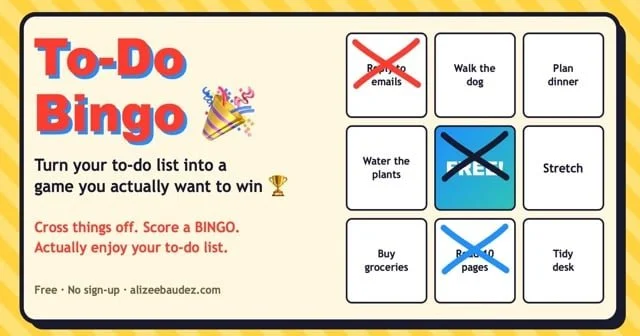
The To-Do Bingo: you paste your to-do list in and it turns it into a bingo card, you cross stuff off with a big marker scribble and get confetti when you finish a row 😂 try it on your list for tomorrow
The blog has been active too: my most recent piece is on ten years of not compromising, what I actually believe about international SEO consulting, after a decade of doing it.
If something in this issue connects to a real problem you're working through, I'm available for new projects. The clearest entry point is a conversation or you can browse what a full engagement looks like here.
See you very soon! 🍓
Alizée Baudez
This was originally sent as an issue of Beyond Organic, my newsletter on international SEO and AI search, on 11 June 2026. If you'd rather get the next one in your inbox than find it here later, subscribe here.