SEO and business blog
Strategic thinking on international SEO, multi-market visibility, and what it takes to actually win in a new market. For in-house teams and brand managers doing this for real.
International SEO before the first hreflang tag: my talk at Google Search Central Live Deep Dive 2026
This is the written version of my lightning talk at Google Search Central Live Deep Dive Europe, in Barcelona on 1 October 2026. You can also get the worksheet that walks you through all three signals on your own site
This is the written version of my lightning talk at Google Search Central Live Deep Dive Europe, in Barcelona on 1 October 2026. You can also get the worksheet that walks you through all three signals on your own site.
The worksheet
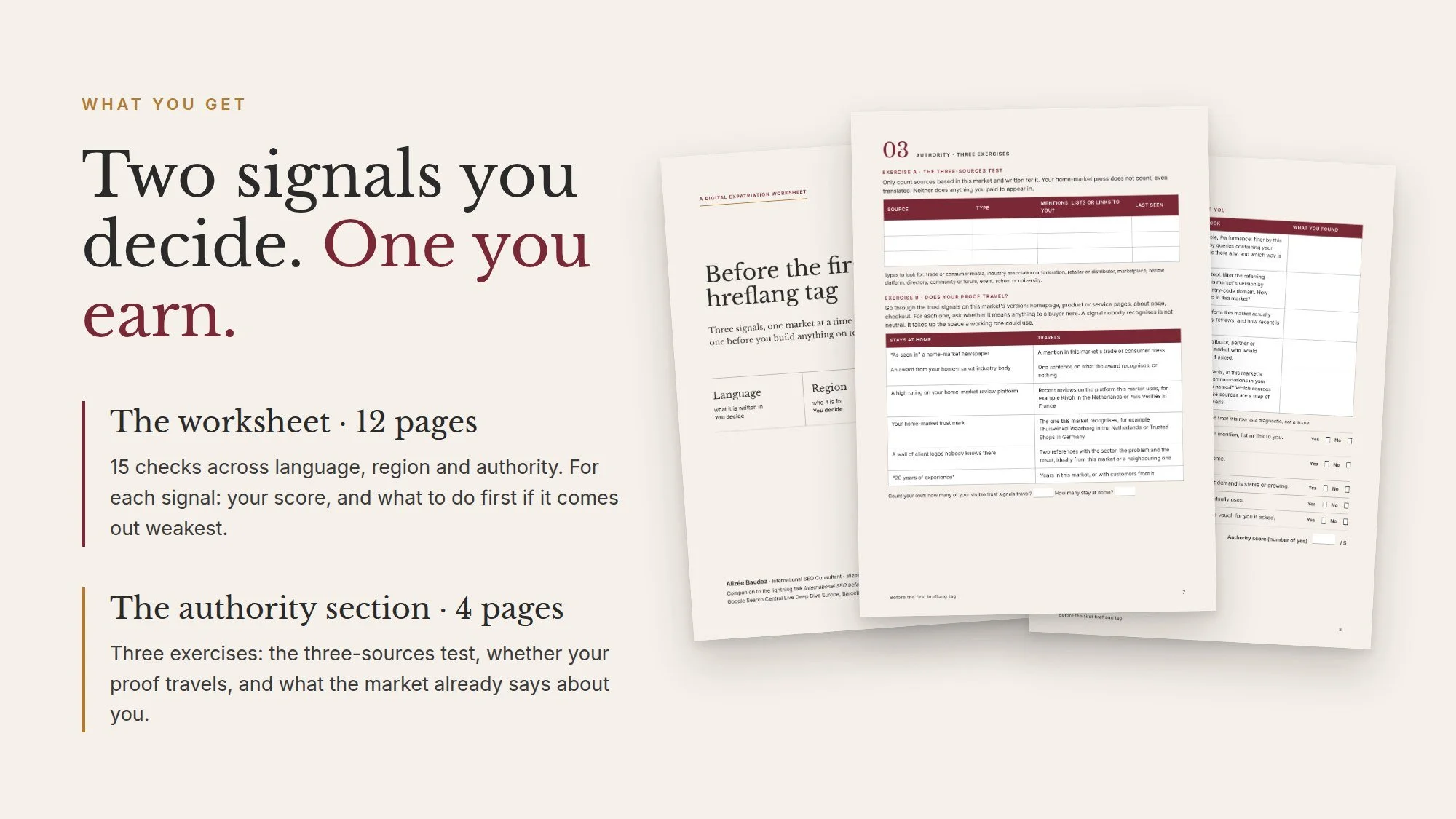
The three questions, as a worksheet you run on your own site, one market at a time. It scores each signal, shows you which one is weakest, and tells you what to do about that one first. The authority section is the longest, for the reasons above.
It is one slice of Digital Expatriation, the framework I use for multi-market search strategy.
A translation with nothing wrong with it
A French furniture manufacturer asked me to audit its multilingual websites ahead of a potential acquisition. They make premium multifunctional furniture. France is the home market, and they sell across Europe.
So I went through every site, and honestly, they had done a good job. Native translators, good content, a decent technical setup. Every site showcased the same products with the same photos. And the Dutch site converted noticeably worse than the rest.
My first instinct was to look at how a major furniture retailer handles the same problem, so I looked at IKEA. Its country sites don't show the same products from one market to the next, and they don't show the same interiors either.
My second instinct was that the Netherlands is small and densely populated, so Dutch homes must be smaller than French ones. That is an instinct, not a strategy, so I checked it. It was wrong. Living space per person is almost identical: 53 m² in the Netherlands (CBS, 2017 figures) against 52 m² in France (INSEE, 2024).


What differs is the shape of the home. In 2019, 58% of the Dutch population lived in a semi-detached or terraced house, against 19% across the EU (Eurostat). Narrow frontage, three floors, and a staircase that is famously not designed for carrying furniture. That is a completely different problem from a wide room on one level, and the Dutch site was still selling to the second one.
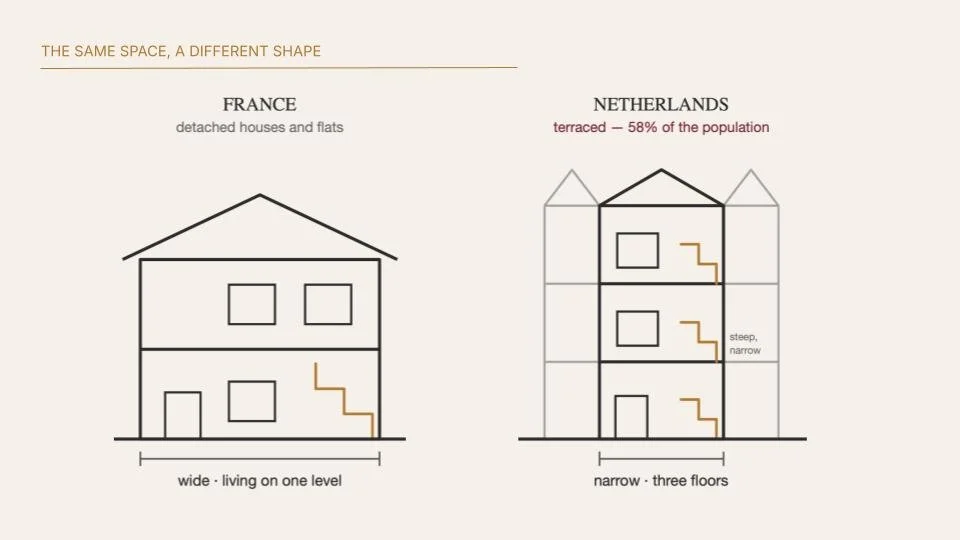
Nothing had been mistranslated. The language was right. The region had never been looked at. So the action plan was about the context the buyers live in, not the words: which products lead in each market, and which rooms they are photographed in. It didn't touch a word of the translation.
There was a second consequence, and it is the one this post is really about. Because the site did not fit Dutch homes, it could not build any authority in the Netherlands either. Nobody links to a shop that does not fit their house. Nobody comes back to it. Nobody in that market has a reason to treat you as real.
Three signals, treated as one decision
Every international site sends three signals, and most teams settle them as a single decision.
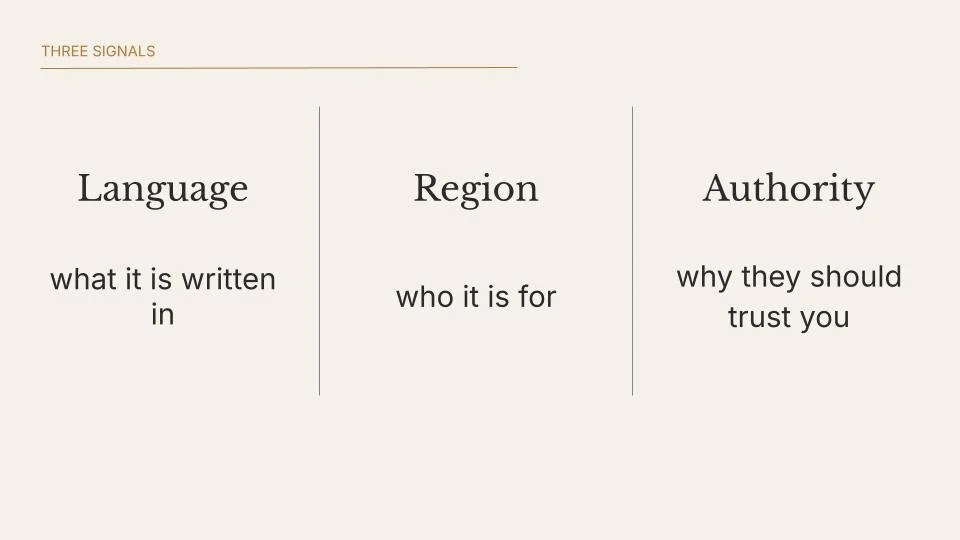
Language is what the content is written in.
Region is who the content is for.
Authority is whether that market has any reason to trust you. Not a toolbar number: actual standing, in that market, judged by that market.
They are not the same kind of thing. Language you decide. Region you decide. Authority you earn, market by market, every time. Two of the three are declarations and the third is an outcome, which is exactly why teams assume the first two confer the third.
They don't. Setting hreflang to de-AT does not make you a thing in Austria.
Hreflang is not the hard part
In 2017, Semrush audited 20,000 multilingual sites and found that 75% had at least one hreflang error. The figure is old, and the pattern has held: an independent 2023 study by Dan Taylor for Search Engine Land found conflicting hreflang directives on 31% of 18,786 international sites, and no x-default on almost half of them.
So the industry has, reasonably enough, decided that hreflang is the hard part. It gets the audits, the validators and the conference slots.
It isn't. Hreflang tells Google which version of a page to show to which user. Google's own documentation frames it as a way to point to localised versions of a page, and Google's search team has repeated for years that it is not a ranking boost. It swaps the right URL into a result the page has already earned. It does not create relevance in a market, and it does not carry trust from one version to another.
You can implement it perfectly on top of three assumptions nobody ever wrote down. The tags will validate. The market will not care.
Language: the decision that usually defaults
The first question sounds too simple to ask. Which language variants do you actually serve?
Most sites never answer it. They inherit an answer from the CMS or the translation plugin, and the answer is one version per language. German means one German. French means one French. That is a decision, even if nobody made it.
Sometimes it is the right one. Often it has simply never been examined. Swiss Standard German does not use the ß. Belgian and Swiss French say septante and nonante where France says soixante-dix and quatre-vingt-dix. Neither detail breaks a page on its own. Both tell a reader, in the first paragraph, whether the page was written for them or forwarded to them.
The other half of the language question is coverage. A translation workflow translates what it can see, and it cannot see much.
I bought a travel cot from a Dutch family business through its French storefront. The page text was in French. Around it, the delivery countdown still spoke Dutch, some product images carried Dutch text baked into the pixels, and the structured data description was in English on every locale. A product description badly translated nearly lost them my purchase!
None of it was visible to the translation tool, because none of it was page text. All of it was visible to me. The structured data is the quietest of the three, and arguably the one that travels furthest: it is a description written specifically for machines, in a language the market doesn't read.
Region: the question that expires
The second question: for each language variant, what genuinely differs between the regions it serves?
Catalogue, price and payment, delivery, legal constraints, seasonality, and what physically fits in the room. Payment is a useful first test because it is so concrete. A Dutch checkout without iDEAL, a Belgian one without Bancontact or a Swiss one without TWINT tells the buyer the same thing the staircase told my client's Dutch customers: this was not built for you.
The method matters more than the list. Look at how someone who has already solved the problem does it. Form an instinct about why. Name it as an instinct, then check it against proper data before it goes anywhere near an action plan. In the audit, IKEA told me where to look. My instinct about Dutch homes was wrong, and checking it is what surfaced the answer that mattered.
Region also has its own geography, and it is not the geography of language. Five years of Google Trends data for ceiling fans shows steady summer peaks in Spain, Greece and Italy, and a much flatter line across Belgium, Germany, Denmark, France, the UK and the Netherlands. Until the summer of 2026, when the northern peak caught up with the southern one and briefly overtook it.
A Spanish brand assessing northern Europe five years ago would have concluded that the north does not buy ceiling fans. It would have been right. It would be wrong now.
So the answers expire. Region is not a language, and it is not permanent. Every answer you write down needs a date next to it, and a date to check it again.
Authority: the one you can't declare
The third question is the one teams skip, and the one the other two quietly depend on. For each region, can you name three local sources that already treat you as present there?
Authority here does not mean Domain Authority or any other third-party score. It means standing inside one market's own information environment: the publications that mention you, the partners and associations that list you, the reviews on the platform locals actually use, the people who search for you by name. Search engines infer that you are a real actor in a market from signals like these. They cannot infer it from your hreflang.
This is why authority does not travel the way content does. You can copy a page into a new subfolder in an afternoon. You cannot copy the fact that French trade media know who you are into the Dutch market. Reputation is built inside an ecosystem, and ecosystems are local. That holds even when everything happens online, and even when everyone speaks the same language.
AI answers make this more visible, not less. A June 2026 study of 128 brands across 12 markets and 13 languages found that 85.7% of the citations AI systems used to describe a brand pointed to sites the brand did not own. The same study found that the mix of cited sources is specific to each market. Its author is affiliated with an AI-visibility vendor, so read it as a strong indication rather than settled science. The direction is hard to argue with all the same. You cannot own your way to local standing.
It also explains the order of operations. When the region is wrong, authority cannot start. The Dutch site had no fit, so it had nobody to earn trust from. Fixing the region would not create authority. It would make authority possible.
The worksheet goes much further on this signal: how to audit it one market at a time, which of your existing trust signals survive the border, and what to do first when it comes out as your weakest.
If you can't answer the third question
This is the rule I closed the talk with. If you cannot name three local sources for a market you already serve, don't open another market. Fix the ones you have.
It sounds conservative. It is the opposite. Two markets with full investment beat ten at surface level, because authority compounds inside a market and does not transfer between them. Every new market you open starts the third signal again from zero.
What the three answers decide
The expensive structural decisions in international SEO come out of these three answers. Made in this order, they stop being expensive.
Your language answer becomes your hreflang set. Which language-region codes exist, whether a regional variant gets its own version or shares one, and where x-default points.
Your region answer decides whether a regional version needs its own content or just its own signals. If nothing genuinely differs between Germany and Austria for your business, a separate de-AT version is a maintenance cost with no upside. If something does differ, a shared version will keep underperforming there, however clean the tags are.
Your authority answer decides where to concentrate. Google's guidance lays out the trade-offs between country-code domains, subdomains and subdirectories, and none of them is a ranking shortcut. What the structure changes is how easily trust consolidates. A market where you have little standing usually gains more from sitting inside a domain that already has some than from starting a new one from nothing.
These are the decisions that turn into migrations when they are made by default. Made after the three questions, they are just decisions.
If you were in the room in Barcelona, I'd love to keep the conversation going. Find me on LinkedIn.
Translation comes fourth: what to get right before you sell in a new market
Translating your website is the obvious first move into a new market, and it belongs fourth. Distance, offer fit and local credibility decide whether expansion works. Here is the order I use, and why it matters more than any single task.
When a business decides to sell in another country, the first budget line usually goes to translation. It's the visible move, the one you can put in a project plan and tick off by Friday. It also leaves everyone with the comfortable feeling that the market has been dealt with, when only the language has.
In the check-up I built for independent experts and small service businesses, translation sits fourth out of five steps. The three steps before it decide whether the translated site ever brings in a client.
Three jobs that get booked as one
Translating changes the language and keeps the meaning. Localising adapts the examples, references, prices and formats to the market. Writing for a market starts from what people there search for and expect, and the source text barely matters any more.
Most expansion budgets only ever pay for the first. The failure that follows is a quiet one: the site works, the pages are indexed, and the enquiries never turn up.
Distance has little to do with kilometres
My English is good. I grew up partly in the UK, lived there, and work in English every day. None of it helped the day I found myself researching drain-cleaning products for the Florida market, wondering with complete professional seriousness whether a chemical solution would cause unnecessary suffering to a snake lost in someone's pipes. My Western European upbringing had not prepared me for that one.
Speaking a language gives you its vocabulary. It doesn't tell you who carries authority in a market, which references people trust, or why they'd pick you over a provider who has been there for years. The people who come unstuck worst in a new market are rarely the ones who don't speak the language. More often, they speak it very well.
International business research calls the gap psychic distance, and looks at it along four axes: language, cultural reference points, how business gets done, and geography. Language misleads the most, because it feels like proximity. Geography still counts for more than most online businesses assume.
Where you land on those axes also tells you what will give way first. If most of them feel close, watch your wording and your site structure, because a shared language hides small, expensive gaps. If only the language feels close (the most common case, and the one people take hardest afterwards), your credibility goes first, since your references mean very little over there.
Does your offer exist there at all?
Expansion rarely starts with analysis. There's an enquiry from abroad, an opportunity, a hunch, and then someone briefs the translator.
The question that gets skipped in between is short and slightly dull: is what you sell, in the form you sell it, bought in that market by people who go looking for it? Search volume won't settle it. Three thousand monthly searches can be people trying to understand a topic rather than hire someone for it, or a need that belongs to a different profession locally. No amount of site work fixes a category that doesn't exist there in that shape. Forty minutes of looking is usually enough to form a view.
Your credibility stays at home
When you sell expertise, what makes you credible sits mostly outside your website: people who know you, publications that have quoted you, peers who would recommend you if someone asked. Your site crosses the border with you. That network stays behind.
Three yes-or-no questions make this measurable. Can you name three publications in the target market that have cited or published you? Three local organisations that mention you in the local language? Does your name come up when you ask an AI assistant about your category, from that country, in its language?
Three noes is the usual result, and a reasonable place to start from. The usual reaction is to publish more articles, which rarely moves anything: nobody else in that market is talking about you yet, and more of your own content won't change that. Credibility work is slow. First signs show after a few weeks, something measurable after four to nine months, and I'd be wary of anyone promising faster.
Then translation, with tested words
By this point translation has something to stand on, and the method shifts: you test words rather than convert them.
Take a freelance developer who translates « création de site sur mesure » as "custom website creation". The English is correct. Buyers in English-speaking markets tend to search for "custom web development", though, and "creation" leans towards design. Her technical service now reads like a design service, and the client who needed a developer scrolls past without recognising what they came for.
Checking this takes an afternoon at most. Search your three main service terms from the target country and see who comes up. Look at how three local providers label the same service in their navigation. Read a couple of local job ads for your profession, where nobody bothers with elegant phrasing. You may end up renaming how people find you without changing anything about what you offer, a change plenty of businesses resist because the two decisions feel like one.
Structure and AI visibility come after
Serving two markets from one site is a solved technical problem. Hreflang and similar declarations tell search engines which version belongs to whom. They don't build any local recognition, and a flawless setup on a site nobody in the market has heard of produces very little.
The last step is the newest one: checking what AI assistants say about you in that market, and whom they cite instead. Twenty-five minutes gives you a baseline, and it's worth re-running a month later.
The full check-up, in French, this autumn
The order above is the backbone of « Vends à l'étranger sans repartir de zéro », a French-language check-up I wrote for independent experts and small service businesses preparing to sell in a new market, francophone or English-speaking. Seventeen checks across six modules, about four hours, no paid tools. You finish with a clear map, your three priority workstreams and a 30-day checkpoint.
Until 6 October 2026, it is part of the Cabinet des Curiosités, the largest bundle of French-language digital products: over 100 guides, templates and tools from independent creators across France, Québec and beyond.
€180 for 12 products of your choice, or €220 for everything
Sales close on 6 October at 23:59 Québec time (05:59 on 7 October in France)
Buyers have until 6 December to unlock their products
Alongside the sale, the free Galerie des raccourcis runs 30 online sessions from 28 September to 2 October
Everything is in French. If you read French, work with francophone clients, or know someone planning a move, it's worth a look.
This is an affiliate link: I earn a commission on purchases made through it, at no extra cost to you.
The order is the strategy
Distance, offer, credibility, words, structure, visibility. Each check is modest on its own. The value is in the sequence: done in this order, each answer tells you what the next one is worth.
Translation still matters. It simply works best as the fourth move of a plan, rather than the first move of a hope.

AI Overviews launched in France. Here's what the markets that went first already know.
Roughly 40% of AI Overview citations come from pages outside the organic top 10. Ranking first no longer protects you. What the markets that went before France already know, and what to do this week.
Update — 07 September 2026: the full guide is live. This piece stays as the launch-day snapshot (July 22); for the France-specific post-launch data (confirmed trigger rate, citation concentration, publisher response), get the full guide below. This is also what resolves, visibly, the three questions the piece ended on.
Cette note est disponible en français → Télécharger le PDF “AI Overviews en France : ce qui vient de changer”
The essentials
Google launched AI Overviews and AI Mode in France on 22 July, two months ahead of the ceiling it gave publishers and without a signed remuneration agreement.
Published impact studies range from -15% to -65% on click-through, because they measure different things. Risk concentrates on informational queries, not on industries.
Roughly 40% of AI Overview citations in Italy come from pages outside the organic top 10. Ranking first no longer protects you, and not ranking first no longer excludes you.
One action is urgent this week: export your Search Console baseline before the pre-launch period slides out of the 16-month window.
What happened this morning
At 7am, Google launched AI Overviews and AI Mode in France. Both at once, desktop and mobile, rolling out progressively over the coming days.
France was the last major market without them. Not for technical reasons, the feature has run in French in Belgium and Switzerland since March 2025. The block was legal, tied to France's neighbouring rights regime, which obliges platforms to pay publishers for reusing their content.
That block just gave way, and it gave way without an agreement.
On 29 June, Google wrote privately to French press editors announcing a launch "no later than 23 September." The letter was revealed by Ouest-France and confirmed by Les Échos and Le Monde. Everyone read that date as the plan. It was a ceiling.
The official announcement came from Sébastien Missoffe, Google France's managing director, and calls it a major milestone. French publishers called it a fait accompli.
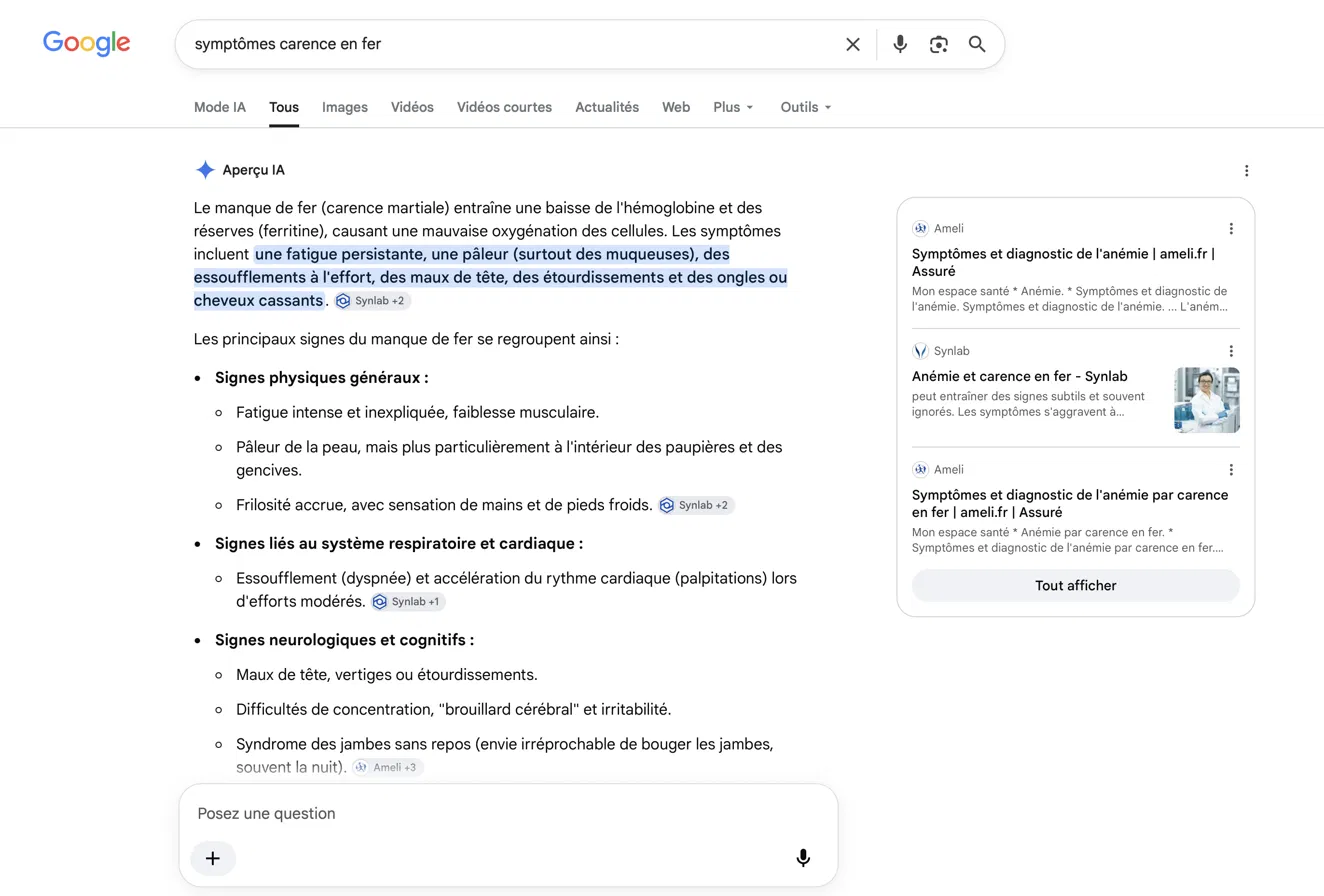
AI Overview on google.fr, “symptômes carence en fer”, captured 22 July 2026.
Why this matters beyond France
If you run search in more than one market, the French launch is the last data point in a two-year natural experiment.
Every major market has now crossed the same line, at different speeds, under different conditions. The US got the feature in May 2024 and watched it fail publicly. Nine European markets followed in March 2025. AI Mode reached 40 countries in October 2025, with France carved out. Now France, two months ahead of a schedule Google itself set.
What this means practically: there is no market left where "wait and see what happens elsewhere" is a strategy. The elsewhere is gone. Everyone is now downstream of the same mechanism, and the only variable left is what share of your traffic sits in the exposed category.
That variable turns out to matter enormously.
What the data actually shows
Not a single number. A range, and the range has a structure.
| Study | Market | Sample | What's measured | Result |
|---|---|---|---|---|
| SISTRIX | Germany | 100M+ keywords | Position-1 CTR with AI Overview | 27% → 11% |
| Ahrefs | Global | 300,000 keywords | Position-1 CTR with AI Overview | -58% |
| Pew Research | US | 68,879 searches | Click on a traditional result | 8% vs 15% |
| Seer Interactive | US | 3,119 queries | Organic CTR, informational | 1.76% → 0.61% |
| SEOZoom | Italy | ~30M keywords | Trigger rate | 54.15% |
Germany → SISTRIX analysed over 100 million German keywords. When an AI Overview appears, click-through at position one falls from 27% to 11%. Across the market, that's 265 million organic clicks lost per month. Johannes Beus, who founded SISTRIX, put it plainly: that traffic isn't coming back.
Global → Ahrefs, across 300,000 keywords: a 58% drop in position-one CTR when an AI Overview is present. In April 2025, the same measurement showed 34.5%. It worsened by two thirds in eight months.
United States → Pew Research Center tracked 900 people across nearly 69,000 searches. With an AI summary present, users clicked a traditional result 8% of the time. Without one, 15%.
Italy → SEOZoom analysed close to 30 million Italian keywords. AI Overviews trigger on 54.15% of searches. Of 168 million visible domains in Italy, the algorithm draws on 175,000 — one tenth of one percent. And roughly 40% of cited links come from URLs that don't rank in the organic top 10 for that query.
Concentration → Ahrefs, across 55.8 million AI Overviews: the top 50 domains capture 28.9% of all mentions.
These figures span -15% to -65% depending on the study. That isn't a contradiction. They measure different objects — browsing behaviour, keyword-level CTR, brand Search Console time series. Anyone citing one number as the answer is either selling something or hasn't read the methodology sections.
The finding that should change your planning
Forty percent of Italian AI Overview citations come from pages outside the organic top 10.
Ranking first does not protect you. Not ranking first no longer excludes you. The two hierarchies do not map onto each other, and most organisations are still managing the first one exclusively.
This is the single most actionable finding in the current data, and it's the one that gets least attention, because it doesn't fit the story either side wants to tell. It isn't a catastrophe narrative and it isn't reassurance. It's a structural change in how visibility is allocated.
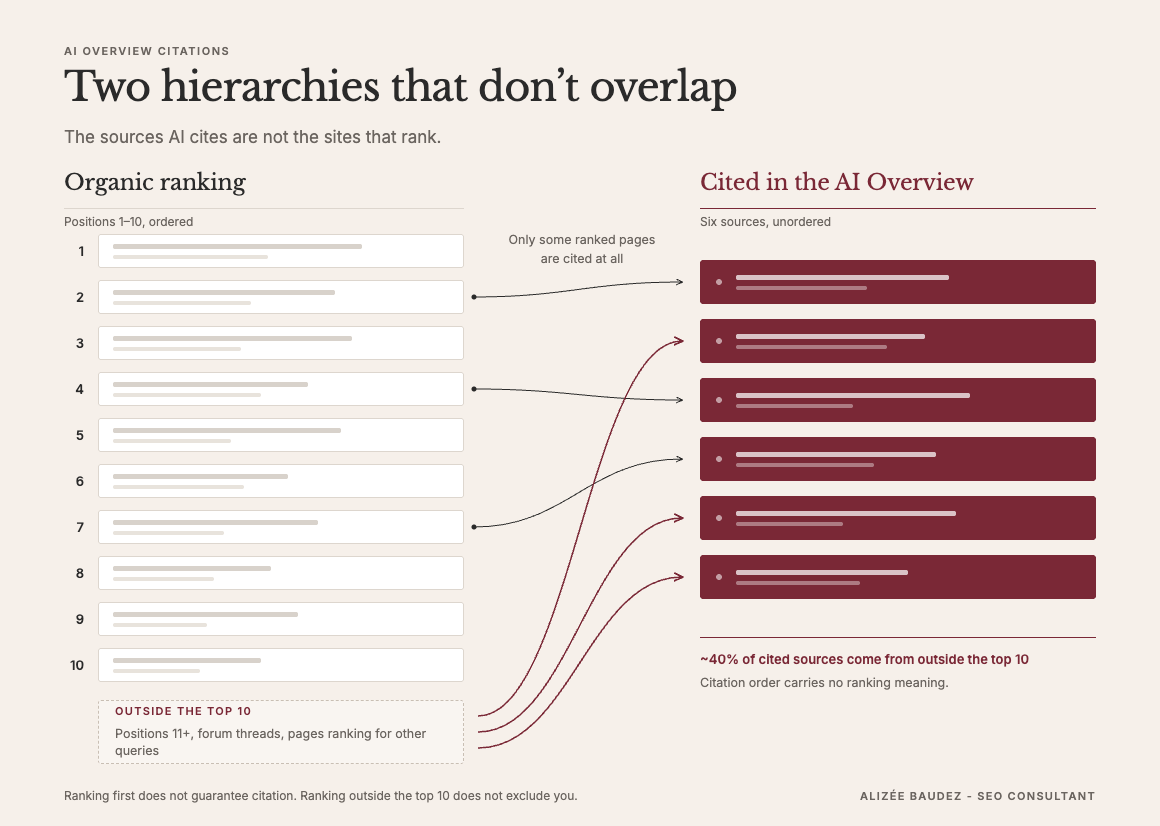
Left: organic ranking, positions 1–10. Right: sources cited in the AI Overview. Roughly 40% of citations come from outside the top 10.
Where the risk concentrates
Sector exposure varies more than most coverage suggests.
In Italy: health at 40.3% coverage, finance at 20.2%, family and community at 19.9%. At the other end, general retail at 4.3%, travel and tourism at 6.4%, sport and fitness at 6.4%. Ahrefs finds the same hierarchy in US data, with health and wellbeing at 43%.
The logic is readable. Google intervenes where a wrong answer causes harm, and holds back where its advertising model is exposed. If you sell, you're spared for now. If you explain, you're exposed.
Which means your risk isn't determined by your industry in the abstract. It's determined by what share of your organic traffic comes from people trying to understand something rather than buy something.
That's a number you can calculate on your own data this week.
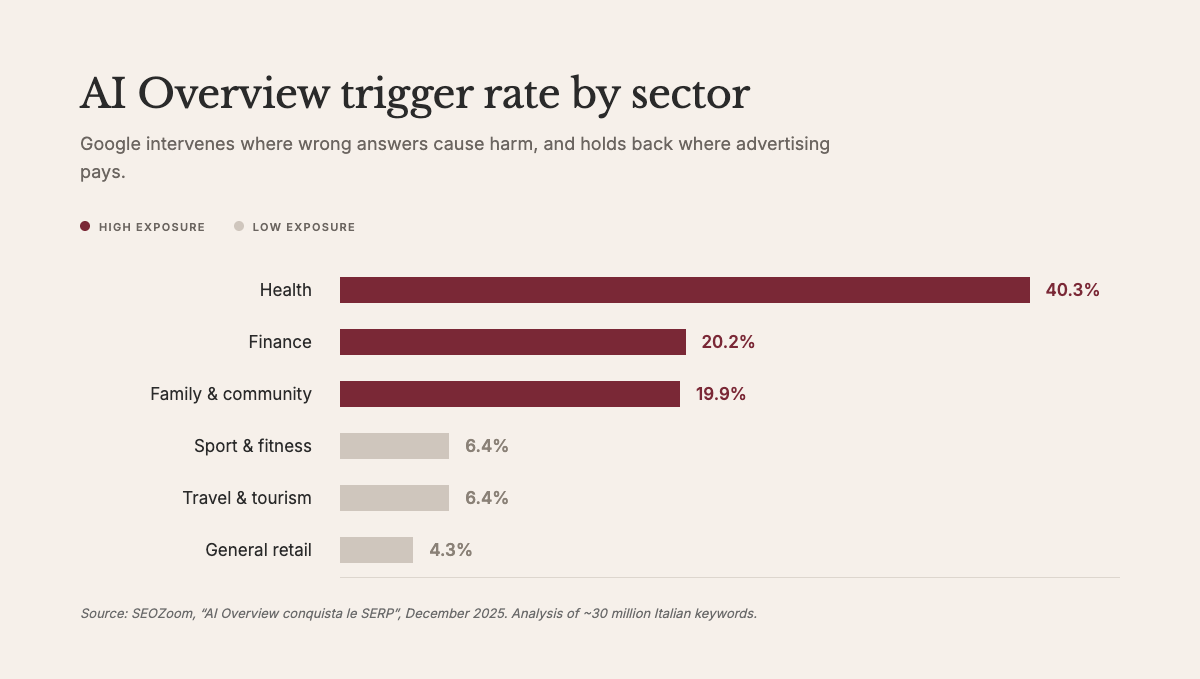
AI Overview trigger rate by sector, Italy, December 2025.
What France reveals about regulatory protection
Here's the part with implications beyond search.
France had the strictest publisher protection in Europe. Two competition authority fines — €500 million in 2021, €250 million in 2024. An active framework agreement covering roughly 450 publications. Ongoing negotiations. A commitment in writing, dated 29 June, naming September.
Google launched in July, during the French summer holidays, without a signed remuneration agreement, two months ahead of its own stated ceiling.
The CPA, GESTE and SPIIL — three French digital publishing and marketing bodies — issued a joint statement criticising the timing and announcing graduated responses. As of today, no legal action has been filed.
If you were counting on regulatory friction to buy you preparation time in any market, this week is the data point that should update that assumption. The strictest regime in Europe produced a two-year delay and then folded on a Wednesday morning in July.
What France gained, and what it lost
Every market that went before France got the rough draft.
Google launched in the US in May 2024, watched its AI recommend putting glue on pizza, and pulled back within a fortnight. Then spent two years restricting, patching, expanding, retreating — in public. Those two years functioned as a visible warning for American, British and German site owners. They watched it arrive slowly enough to react.
France got the finished product. No observation phase, no gradual ramp during which anyone adjusts. Same mechanism, higher step.
What France did gain is two years of data produced by other people. Germany, Italy, Spain and the UK have already measured what happens. Those numbers are public and they constitute a map the pioneer markets never had.
The delay was never a reprieve. It was an information advantage, for anyone who used it. It expired this week.
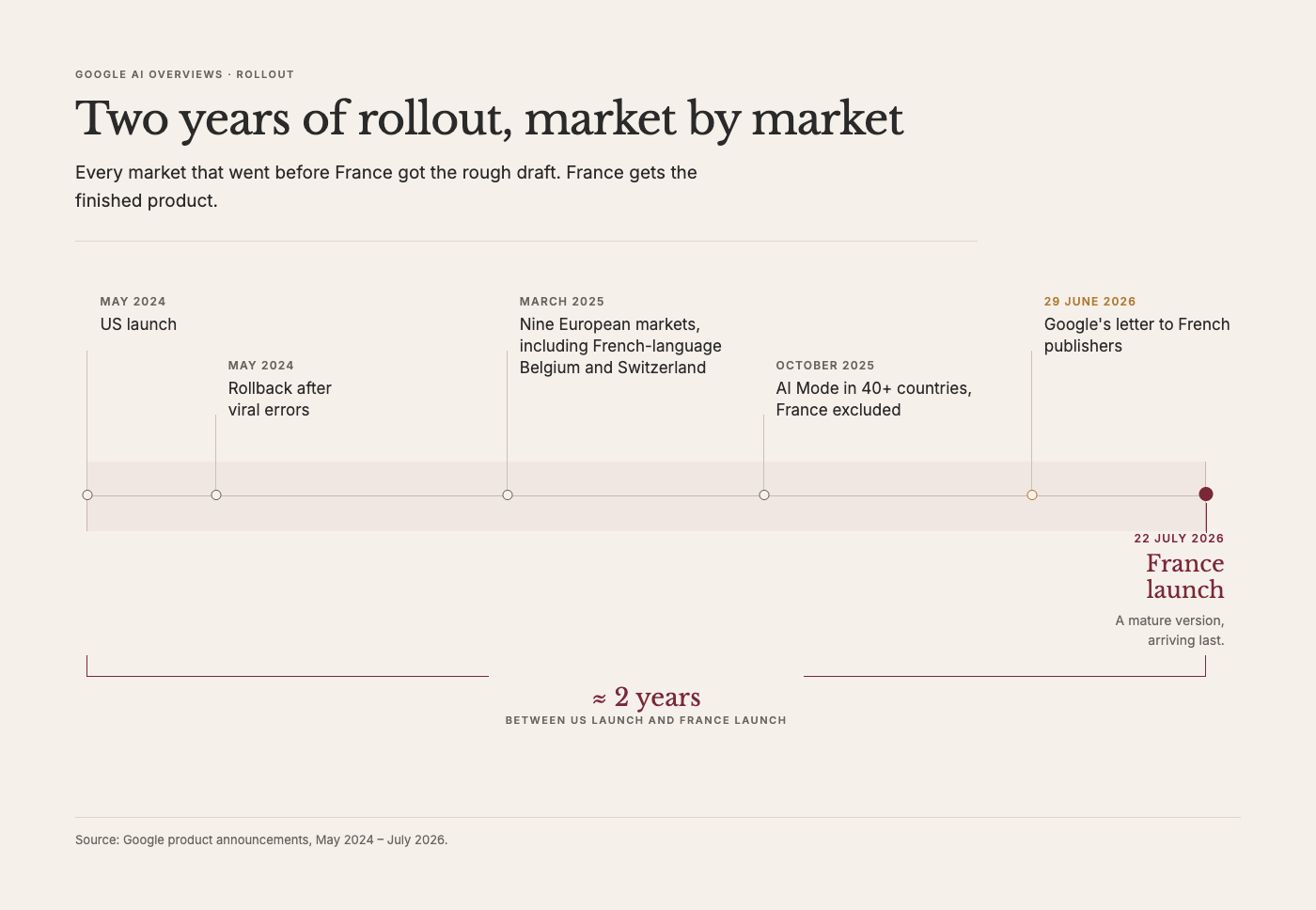
Two years separate the US launch (May 2024) from the France launch (July 2026).
What to do now
For anyone with French traffic, one action is genuinely urgent this week. The rest can wait.
1. Capture your Search Console baseline
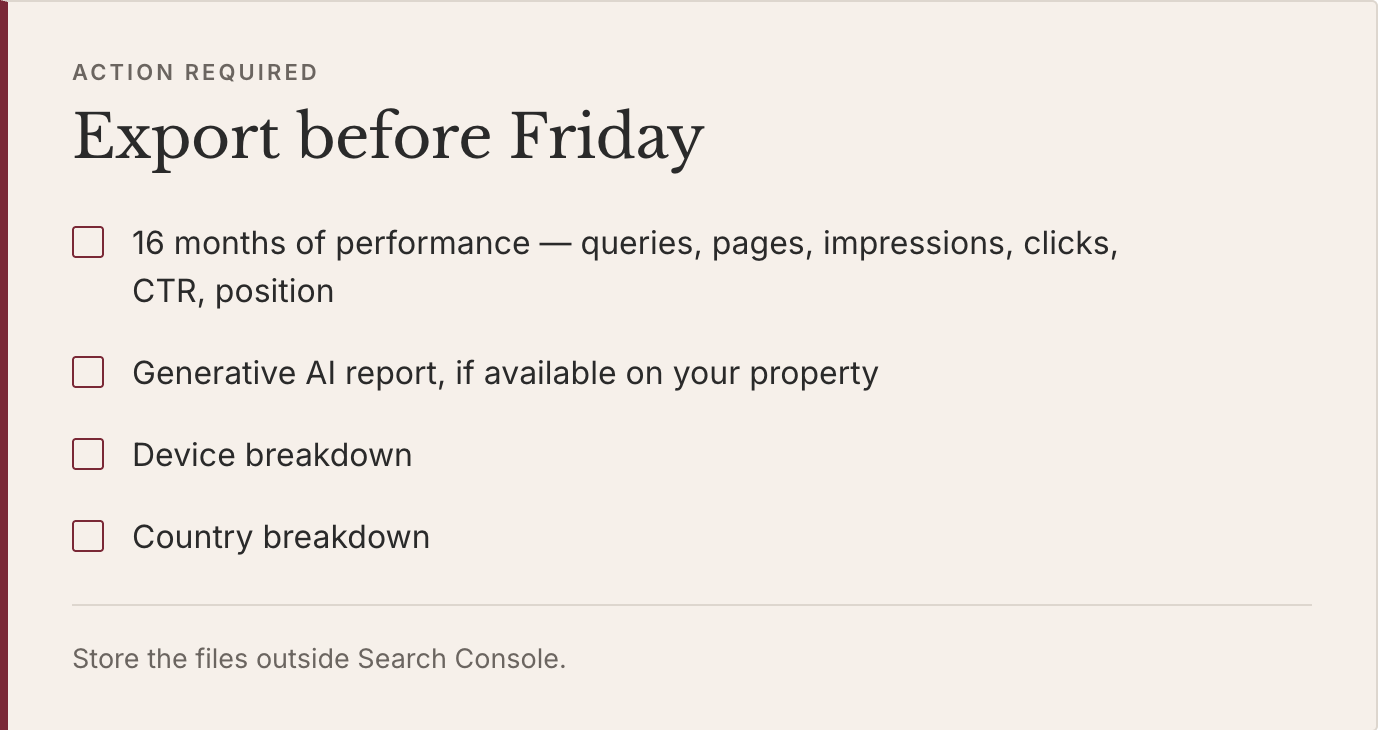
Search Console holds a rolling 16-month window. Your pre-22-July data isn't gone today, but it will slide out of that window over the coming months. If you don't export it, it becomes unrecoverable — barring an external backup like BigQuery, which most organisations don't have.
Export this week:
16 months of performance: queries, pages, impressions, clicks, CTR, average position
The Generative AI report, if available on your property
Device and country breakdowns
Store the files outside Search Console.
In October, someone senior will ask whether a traffic decline is AI or execution. Without this baseline, that question has no clean answer.
2. Segment traffic by intent
Calculate what share of your organic traffic comes from informational queries. Above 30%, your exposure is real and you should act in September. Below 10%, observe.
This takes half a day and it determines everything else.
3. Watch the impressions-to-clicks gap
Stable impressions with falling clicks means you're being cited and nobody is clicking through. This decoupling is the first symptom observed in every market. Track it page by page, not at site level.
What not to do
Don't extrapolate German numbers directly. Different query mix, different publishing landscape, 16 months of divergence. Those figures give you a range of scenarios, not a forecast.
Don't opt out reflexively.Seer Interactive data shows brands cited in an AI Overview get 35% more organic clicks than those that aren't. The opt-out is domain-level, not page-level, and granular control isn't scheduled until March 2027. It's a genuine trade-off, not an obvious protective measure.
Don't restructure content this month. The rollout is progressive. Seeing AI Overviews on some queries and not others in July is expected. Wait for three or four weeks of French data before making structural decisions.
What the French data confirmed
The guide below answers the three things I was watching in July:
France's trigger rate: 52.63% (SE Ranking, 100,000 keywords) — landing between Germany (~20%) and Italy (54.15%). [Who gets cited — your finding] [What publishers did — your finding]. Full breakdown, including the transborder section, in the guide →
Citation is highly concentrated: 9 domains capture 25% of all citations. YouTube appears in 1 in 2 AI Overviews. French-language content is cited 89.34% of the time.
What publishers did: APIG filed a formal complaint with France's competition authority. The Autorité de la concurrence's Meta ruling is the likely template for resolution.
The full breakdown, including the transborder section, in the guide →
Working on French market visibility? Get in touch!
Download Your Guide to AI Overviews in France
This free guide is built for international marketing and SEO leads with a presence in France who need to know if this changes their numbers, and agencies advising French or France-facing clients this quarter. Contains France-specific post-launch data and a cross-market comparison (Germany, Italy, Spain, US).

Sources
Launch and official communication
Google France — Lancement des Aperçus IA et du Mode IA en France (Sébastien Missoffe, 22 July 2026)
Abondance — Google lance officiellement les AI Overviews en France
Blog du Modérateur — Google déploie AI Overviews et AI Mode en France
Publisher response
Journal du Net — Google lance AI Overviews en France sans concertation avec les éditeurs de presse
Archimag — Google déploie AI Overview en France et engage un bras de fer avec les éditeurs de presse
Impact data — markets that launched first
SISTRIX — AI Overviews in Germany (Johannes Beus, 100M+ keywords)
PPC Land — AI Overviews cost Germany 265M organic clicks monthly
Ahrefs — AI Overviews Reduce Clicks by 58% (300,000 keywords)
Ahrefs — AI Overviews Reduce Clicks by 34.5% (original study)
Pew Research Center — Do people click on links in Google AI summaries? (900 people, 68,879 searches)
Seer Interactive — AIO Impact on Google CTR (3,119 queries, 42 organisations)
SEOZoom — AI Overview conquista le SERP (Gennaro Mancini, December 2025, ~30M Italian keywords)
Tools and mechanics
International SEO Readiness: What to Establish Before Your Market Entry Brief Goes Out
Most international SEO investment isn't lost during execution. It's lost in the gap between a board-approved expansion and the brief someone wrote to deliver it. Demand fit, market knowledge, local authority: three things worth establishing before your agency starts with keyword research.
Your board approved a market expansion. Someone translated that into an agency brief. Six months later, the market isn't performing and everyone has a plausible explanation.
This is a familiar sequence, and it's preventable, but only if the questions that should precede the brief are actually asked.
Most of them aren't. Not because they're difficult, but because there's no natural moment to surface them once commercial momentum has built. The targets are set. The timeline is agreed. The brief feels like progress. The readiness question — whether the conditions for organic success in this market actually exist — tends to be treated as the agency's problem to solve, not yours to answer first.
It isn't. And the gap between those two assumptions is where most international SEO investment gets lost.
If you're planning a market entry and organic search is part of how you intend to compete there, here is what to establish before the brief goes out.
Can organic actually support this expansion?
The commercial decision to enter a new market usually arrives well before the SEO conversation begins. Board mandate, revenue targets, competitive pressure: by the time the SEO team is involved, the question has already shifted from "should we invest in organic here?" to "how do we build the organic strategy here?" That shift closes off the most important conversation you can have — because the second question assumes an answer to the first that nobody has actually validated.
Three things need honest answers before any strategy is scoped.
Demand fit. Does your offer category generate organic search behaviour in this market, at the right stage of the buying journey? Volume alone doesn't answer this. A market can produce convincing keyword data that never converts — because the intent doesn't match the product, because purchasing decisions happen through different channels, or because the category doesn't exist locally in the same form it does at home.
I've worked with clients whose target market had solid keyword numbers on paper. Once we studied the actual SERPs and local buyer behaviour, the searches were informational with no clear commercial pathway. The data looked like validation. It was justification.
Competitive viability. What does the SERP landscape tell you about the cost of organic entry in this market specifically? Some markets have local players with a decade of domain authority and deep editorial relationships that no content programme will displace within your commercial timeline. When that's the picture, your organic timeline and your revenue timeline need to be in the same conversation — not sequenced, with SEO expected to close the gap later.
The actual search environment. What does ranking well mean in this market, right now? AI search features vary significantly by language, geography, and query type, with direct implications for how organic visibility translates into traffic and revenue. At the time of writing, France has been excluded from AI Mode entirely, while Germany, the UK and the US are at different stages of AI Overview integration. A realistic organic forecast has to reflect the search experience your target audience actually has — not a generic assumption about what a top-ten position delivers.
These three variables don't produce a yes or no. They produce a calibrated view of what organic can realistically contribute — and when that view exists before the strategy is commissioned, rather than after it stalls, it changes both the brief you send and the work you get back.
The brief you send should specify market knowledge, not just language
The most expensive assumption in international expansion planning isn't a technical one. It's the idea that knowing a language is the same as knowing the market, and the decisions built on top of it.
Language gives access to vocabulary. It doesn't give access to trust signals, buying behaviour, or the specific reasons someone in that market would choose you over a local competitor who has been present for years.
A French furniture retailer I worked with had done everything right linguistically. Their Dutch-language site was accurate, keyword-optimised, and structurally sound. Traffic was arriving. Conversions weren't. When we looked at what was being promoted on the Dutch homepage, the problem was immediate: the hero products were the same large sectionals and oversized storage units that moved well in France. Dutch apartments are, on average, smaller. The product range wasn't wrong — it was wrong for how people in the Netherlands actually live. No keyword tool surfaces that. Understanding the local housing market does.
I call this [Digital Expatriation]: studying a market's information environment — its search results, its content formats, its consumer context — before opening a keyword tool or writing a content brief. The objective is to understand how the market behaves, not to translate your existing strategy into its language.
What gets missed without it follows consistent patterns. Content that passes linguistic review but fails behavioural expectations. Trust architecture that differs significantly by market: German readers expect citations as a baseline credibility signal; Brazilian audiences default to local case studies and short video; Japanese readers weight a mention in a local trade publication more heavily than international domain authority. These aren't stylistic preferences. Getting them wrong produces content that is technically correct and commercially invisible.
The brief you send should specify that your agency — or your in-house team — needs to demonstrate market knowledge before keyword research begins. Not language proficiency. Market knowledge. They are not the same requirement, and conflating them is where strategies start to drift before they've launched.
Three decisions that belong in the brief, not the post-mortem
The structural problems that surface six months into an international programme almost always trace back to decisions that were never made before the strategy began. Not wrong decisions — absent ones.
Language, region, and authority are three separate signals.
Language describes what content is. Region describes who it's for. Authority describes whether a market-specific version of your site should rank in that market. A strategy that conflates them — treating "French content" as covering France, Belgium, Switzerland, and Canada without distinction — creates a structure that sends conflicting signals and is expensive to unpick once it's live.
[Hreflang], the technical mechanism most agencies will reference in their proposals, sits inside this decision. It resolves ambiguity within a coherent structure — it does not build local relevance, and it does not transfer authority between versions of a site. Treating it as the solution to an international architecture that was never properly designed is one of the most common and most expensive errors in multi-market SEO.
SEO requirements must be integrated into the localisation workflow, not added after it.
Translation processes built without SEO input undo optimisation work. They routinely overwrite title tags, flatten internal linking, and erase metadata that was carefully built in the source version. The localisation team isn't at fault — they're following a process that was designed without SEO in mind.
The question to answer before localisation work begins: who owns SEO sign-off within that workflow, and what does handover look like? Without a named owner, the localisation process wins by default. If your SEO team's first deliverable after a market launch is rebuilding what already existed in the source version, this decision wasn't made before the strategy started.
Governance: what can be decided locally, and what can't.
Global teams push for consistency. Local teams push for relevance. Both are right, and the tension between them only becomes productive when three things are explicit: who can approve local content decisions without escalation, who manages in-market contributor relationships, and what happens when local and global priorities conflict. You don't need a governance restructure to establish those three things. You need a document that exists before the first local market goes live.
Your brand's authority doesn't cross borders automatically
A strong domain doesn't carry its authority into new markets the way you might expect. The logic that a trusted domain benefits its own subfolders and subdomains isn't wrong exactly — Google does use domain-level signals. What doesn't transfer is local relevance, local recognition, and local editorial relationships.
Authority built in one market is closer to a professional reputation than a financial asset. It's legible in the context where it was earned, and largely invisible everywhere else. A brand that has spent years building domain authority in the UK is not approaching Germany from a position of strength. It's approaching it with zero local presence and a global domain that local publishers, local journalists, and local AI systems may not recognise at all.
Before a market launch, the honest question is: what local presence do you actually have, versus what are you assuming? Three things worth establishing before the strategy is commissioned:
Can you name three publications in this market that have cited your brand?
Three local entities — partners, associations, media outlets — that reference you in the local language?
Does your brand appear in local-language AI-generated results when users query your category?
If the answer to all three is no, the first investment isn't a content strategy. It's a local presence strategy — and it belongs in the planning phase, not as a follow-up workstream once the programme has launched and isn't performing.
The AI dimension compounds this. Analysis of over 1.3 million citations across Google AI Overviews and ChatGPT found that translated websites receive 327% more visibility in AI search than untranslated ones, with that advantage extending to the original-language content on those sites. AI systems don't process hreflang. Local relevance has to be legible at the entity level — your brand needs to be recognised as a genuinely local actor, not just localised into the language. Local authority building is now also an AI visibility decision, and the returns compound in favour of brands that start early.
Two markets with this groundwork in place will consistently outperform ten markets where it was assumed.
The brief your agency won't ask you to write
The agencies that deliver on international briefs aren't necessarily the ones with the most impressive credentials. They're the ones that ask the uncomfortable questions before scoping anything — about demand fit, about what local authority actually exists, about whether the localisation workflow is built to preserve SEO value.
Most don't. Most start where it's comfortable to start: keyword research, content architecture, technical recommendations. These are legitimate workstreams. They're also the wrong starting point if the foundational decisions haven't been made.
The readiness question isn't a risk-management exercise. It's how you avoid commissioning a strategy that performs well on paper and fails in market.
If you're planning a market entry and want to establish whether the conditions for organic success are actually in place before the brief goes out, that's exactly what an [Assessment Call] is for. [Book a call →]
International GEO: why multi-market brands need a different framework
I've watched brands rank #1 in Google in a market while being completely invisible in AI search results in that same market. The two problems look similar. They're not. This is the framework that addresses both.
I've audited international sites in half a dozen languages and watched brands rank #1 in Google in a market while being completely invisible in AI search results in that same market.
The two problems look similar. They're not.
If your brand operates across multiple markets, or you're building toward expansion, most of the GEO advice filling your feed right now covers maybe 30% of your actual situation. The rest is a different problem entirely, and it requires a different framework to address.
This is what that framework looks like, why it diverges from standard single-market GEO practice, and what it means for how AI search actually works when language and geography are in the picture.
Why AI search changes the international problem, not just the stakes
To understand why international GEO — or AI Search, or AEO, or AIO, etc — is a distinct discipline, you need a working model of how AI search retrieves and generates answers. AI Search behaves differently from traditional search in ways that matter specifically for multi-market brands.
Traditional search matched your page to a query. The signals were largely on-page: keywords, authority, links. International SEO added layers (hreflang, localised content, local link equity) but the fundamental logic held. Rank well, get found.
AI search works differently. When a user submits a query to an AI-powered search interface, the system doesn't retrieve a ranked list of pages. It retrieves passages — specific sentences and paragraphs dense enough with information to serve as grounding material for a generated answer. The quality threshold for what gets extracted and cited is much higher than what's required to rank. And the retrieval process itself is more complex: for any substantive query, AI systems generate multiple concurrent background searches — a behaviour known as query fan-out — to build a complete picture before synthesising a response.
What this means practically: your brand isn't competing for one search result. It's competing to be the authoritative grounding source across all the related sub-queries the AI generates when a user asks something in your category. In English, in your home market, you may already have the depth to win that competition. In French, German, or Japanese — if your content there is translated rather than built for the market — you probably don't.
That's the gap. AI search doesn't just reflect your international SEO gaps; it amplifies them, and adds new ones that traditional SEO never surfaced.
The single-market GEO playbook and where it stops working
Standard GEO advice, the kind that's been everywhere since AI Overviews launched, is built around a coherent set of principles: make your brand entity clear, produce specific and citable content, build structured data, earn mentions from sources AI models trust. Good advice. All of it applies internationally too.
What it doesn't account for is the way these signals fragment across languages and markets.
Entity clarity is a useful example. AI tools don't index pages the way search engines do. They form a working understanding of what your brand is (your category, your offer, your position) and that understanding is constructed separately per language, from different inputs, weighted differently by different models. A brand with strong, accurate AI representation in English can produce vague, hedged, or absent results when the same query runs in French or German. Not because anything is technically broken, but because all the inputs that build entity understanding — Wikipedia entries in local languages, Wikidata completeness, schema markup on localised site versions, consistent descriptions across local directories — were maintained in the home market and neglected everywhere else.
The same fragmentation happens with content signals, authority signals, and technical signals. The single-market GEO playbook treats these as things you do once, globally. International GEO treats them as things that have to be established per market, because the AI systems evaluating your brand in each market are drawing from that market's web ecosystem, not a global one.
AI search features also roll out unevenly across markets and languages. The specific AI search experience a user in Germany has today is different from what a user in France or Japan has. Query types that trigger AI-generated answers vary by geography. Citation patterns differ by language. A realistic international GEO strategy has to account for what AI search actually looks like in each target market, not assume a uniform global experience.
What breaks specifically: five areas where the gap opens
After running this audit across multiple client engagements — and building the International GEO Checklist to systematise it — five areas consistently determine whether a brand achieves genuine AI visibility across markets, or just in its home language.
Entity signals per market
This is where most brands have the largest gap, and where the leverage is highest.
AI tools synthesise their understanding of your brand from many sources: your website, third-party profiles, press coverage, structured data, Wikipedia, Wikidata. In your home market, most of those inputs probably exist, roughly agree with each other, and give AI models enough coherent signal to describe you accurately.
In a second or third market, the picture is usually thin. The local-language Wikipedia entry doesn't exist. Your Wikidata record is incomplete. Your Organisation schema doesn't appear on the French or German version of your site. Local directories describe you in slightly different terms than your website does. The result is an AI that either hedges its description of you, describes you generically, or defaults to whoever it's more confident about — which is often a local competitor with a decade of local web presence behind them.
The fix isn't glamorous: audit how AI tools currently describe your brand per market and language, close the structured data gaps, and ensure the inputs that build entity understanding are consistent across every version of your site and every profile that matters locally.
Content that survives the retrieval threshold
Query fan-out is the mechanism that makes this concrete. When a user asks an AI tool a substantive question in your category, the system generates multiple sub-queries to build its answer. In English, if you've built real depth on your topic, you may appear in the grounding material for several of those sub-queries. In French, if your content there is a translation of your English content, you probably appear in none of them, because translated content rarely meets the retrieval threshold AI tools apply when pulling passages to ground a response.
The threshold is specificity. AI tools extract sentences that are self-contained, information-dense, and specific enough to be used independently of their context. Content written for one market's context and translated into another's language typically fails this test. The examples reference the wrong geography. The terminology doesn't match what local professionals actually use. The conditions that make a claim relevant in one market don't apply in another.
Translation is a linguistic operation. Making content citable in a local market is a different operation entirely, one that requires local examples, local register, and local context. A focused page that directly answers one question a local audience is actually asking will outperform a comprehensive guide translated from English every time.
Technical signals across market versions
Standard technical GEO guidance (structured data, crawlability, page speed) applies internationally, but with compounding complexity that creates problems even when individual elements are correctly implemented.
Most brands implement schema on their primary language site and launch language variants without replicating it. The French version of a page has no Article schema, no FAQ schema, no Organisation markup. Hreflang implementations are frequently broken in ways that confuse which version of a page is intended for which audience. Canonical tags on localised pages sometimes point back to the English version, signalling to Google that the local content is a duplicate. AI retrieval systems that draw from Google's index inherit all of this.
None of these errors require deliberate negligence to accumulate. They're the predictable output of localisation processes that were never designed with SEO — let alone AI visibility — in mind. The decision that fixes this isn't a technical one; it's a process one. Who owns SEO requirements within the localisation workflow, and what does sign-off look like?
Local authority that AI tools recognise
Your website is one input. AI tools read the entire web about you.
When an AI tool forms a response about your brand in German, it draws from German trade journalism, German industry association sites, German review platforms, German-language content from competitors that mention you. The picture it builds is the sum of what the German-language web says about you — not what your website says about itself.
For most international brands, that picture is thin. Not because the brand lacks substance, but because all the investment in PR, thought leadership, and authority-building went into the home market language. The local-language web ecosystem received very little.
This is the part of international GEO that generates the most discomfort in client conversations, because it reveals how much of international marketing investment has been surface-level. A brand can have a beautifully designed French-language site, a French social media presence, and a French-speaking sales team, and still have almost no footprint in the French-language web ecosystem that AI tools actually draw from. Trade press mentions. Partner references. Review platforms. Association listings. These feel like side tasks. They're the authority layer.
Authority built in one market doesn't transfer to another. It's closer to a professional reputation — legible where it was earned, largely illegible everywhere else. A brand that has spent years building domain authority in the UK is starting from zero local relevance in Germany, regardless of what its domain rating says.
Monitoring per market, not per tool
Standard GEO monitoring advice covers which AI tools to track and which queries to run. The international version adds a dimension: results vary not just by tool, but by market and language, often significantly. A query that returns accurate brand representation in one language can return a competitor, a hedged description, or nothing at all in another.
Without a structured monitoring cadence that tests your query set across tools and across markets, you won't know which markets have a visibility problem until someone on the ground mentions it. By that point, the competitor who has been building local signals quietly for eighteen months is the one AI tools are confidently recommending.
The compounding problem: why this matters now
AI search doesn't just change how users find information. It changes where brand preference is shaped.
The research phase (where a buyer forms a shortlist, evaluates options, and develops a point of view) is increasingly happening inside AI search interfaces before a single site visit is made. For international brands, if you're not present in that phase in a given market's language, you're not on the shortlist. You may not exist in that buyer's consideration at all.
The brands that tend to be confidently cited by AI tools in non-English markets share a common characteristic: they built local signal infrastructure intentionally, over time, before it became urgent. Local press relationships. Market-specific content written for that market. Structured data that tells AI tools who they are in every language they operate in. Partner and association mentions in the local web ecosystem.
This isn't a new set of tactics layered on top of existing SEO. It's a different orientation: from building a globally consistent brand presence to building genuine local relevance in each market, then making that relevance legible to AI systems.
Two markets done properly will consistently outperform ten markets done at surface level. The question isn't how many markets you can launch into. It's how many you can genuinely be present in.
Where to start
If you're running international SEO and haven't yet audited your AI visibility per market, the starting point is straightforward:
Open an incognito browser, set a VPN to your highest-revenue international market, and run five queries across ChatGPT, Perplexity, Claude and Gemini, in the local language. Two brand queries, two category queries, one comparison query against your main competitor. Document what comes back.
What you find will tell you more about your international GEO gaps than any keyword report. Strong, accurate English results alongside vague or absent local-language results is the most common pattern, and the gap you find is your starting point.
From there, the five areas above give you a prioritisation framework: entity signals and content quality first, because they produce the most direct AI visibility improvement. Technical signals next, because they determine whether your existing work is legible to AI retrieval systems at all. Local authority last, because it's the slowest work to compound, which means it's also the most urgent to start.
→ International GEO Checklist — a 24-item audit across the five areas above, built specifically for in-house SEO and marketing managers at companies operating across multiple markets. Includes a companion Google Sheet to score your status per market and track progress over time.
How Lipton Teas & Infusions built US search visibility from Scratch, and what it required
A corporate rebrand, four audiences, and a brand name dominated by a competitor. How the architecture decisions made before launch determined every result that followed.

The Lipton name gets searched thousands of times a month in the United States. Nearly all of those searches are about iced tea. Almost none of them are about the FMCG group that owns Pukka, PG Tips, Tazo, and T2.
When Ekaterra rebranded as Lipton Teas & Infusions and launched a new corporate site from zero, this was the problem waiting at the other end of any standard SEO approach: rank for "Lipton" and you drown in irrelevant traffic from consumers who want cold drinks. Avoid it entirely and you have no anchor for the brand at all.
The brief was clear. US market. Employer brand visibility. Zero organic baseline. Getting the architecture wrong before launch would mean spending the next two years undoing it.
The situation
The new site, liptonteas.com, needed to serve four completely different audiences: job candidates searching for careers in the US, press and analysts researching the group, retail and distribution partners, and investors. Each audience had different search intent. Content built for one would actively work against the others if the URL structure and content architecture weren't designed to separate them before a single page went live.
The cannibalisation risk was real. The group's product brands — Pukka, T2, Tazo, PG Tips — each have their own websites and their own SEO strategies. A poorly designed corporate site would bleed equity into the wrong places and confuse search engines about which brand owned which audience. And the former parent company, Unilever, still carried strong search association with the Lipton name. The brand confusion wasn't a marketing problem. It was a structural one.
What determined the outcome
No keyword work started until the competitive landscape was mapped. Which FMCG groups were competing for the same US talent pool? What benefits and values were they communicating? Where were they winning, and where were the gaps?
Lipton Teas & Infusions already had genuine strengths — a serious sustainability commitment, strong diversity, equity and inclusion practices, competitive benefits. But without knowing how competitors were positioning those same attributes, any content strategy would have been generic rather than deliberate.
The keyword research came second, built from scratch for the US market. Not adapted from a European strategy. Not translated from another language. Each of the four audience segments got its own research layer: careers queries by job title and US geography, investor and analyst search patterns, wholesale and distribution queries for retail partners, press and research behaviour from journalists. And critically, a defined set of queries was explicitly excluded from the strategy — consumer product searches, iced tea queries, customer service topics — to protect every relevant visit from day one.
The architecture and content recommendations came last, grounded in that research. URL structure, content pillars, internal linking logic, and page-by-page intent mapping were all finalised before the site launched.
What happened
The site launched in July 2023. By January 2024, it had reached 7,900 monthly organic visits worldwide. Every primary employer brand query in the US ranked number one — "lipton careers," "lipton tea jobs," "lipton tea employment" — all from a standing start, with no paid traffic. The architecture held: no cannibalisation with the product brand websites was observed across the group's entire search footprint.
The traffic the site attracted was the traffic it was built for. That is not a given.
Three things this project made clear
Architecture decisions made before launch determine the results. Retrofitting SEO to a live site is harder, slower, and more expensive than designing the structure correctly from the start. The URL decisions, content pillars, and audience segmentation choices made before a single URL was published determined what was possible in the first five months.
On a high-stakes launch — a rebrand, a new market entry, a corporate site serving multiple audiences — SEO strategy is not something you add to the project plan after design is approved. It is an input to design.
US keyword research is not a translation of a European strategy. Search behaviour for employer brand queries differs significantly between markets, not just in language, but in the topics that matter, the values that influence candidate decisions, the specific vocabulary around DEI and remote work that US candidates actually use. A strategy built from the US market upward, rather than adapted from somewhere else, generates relevant traffic rather than technically correct traffic.
Knowing which queries to exclude is as important as knowing which to target. For any brand operating in a complex ecosystem — multiple subsidiaries, shared naming with another company, a history under a different parent — the discipline of deciding what you will not rank for protects the entire content investment. Every exclusion decision in this strategy was a budget protection call, not just an SEO one.
Is any of this relevant to your situation?
This project was a launch. But the same principles apply to any brand navigating a rebrand, a new market entry, or a corporate site trying to serve multiple audiences without confusing all of them.
If you are about to launch something and haven't yet decided the architecture, that decision is costing you more each week it's deferred. If you've already launched and the traffic doesn't reflect the audiences you need, the work is recoverable, but the earlier it starts, the less you undo.
The full case study presentation — including keyword rankings, traffic data, and the complete strategic approach — is available to download here.
If you're working on a project with similar constraints, a short assessment call is the fastest way to find out whether my approach fits what you're trying to solve.
Ten years of not compromising: what I actually believe about international SEO consulting
I registered a business in March 2016 to invoice €150 for two CV rewrites. Not exactly a founding myth. Ten years later, here's what I'd actually stake my reputation on.
There's a version of this post where I list ten things I learned in ten years. You've read it before, written by someone else, and you didn't finish it.
This isn't that.
Time is short. At some point in my mid-twenties, that stopped being a philosophical observation and became a practical one. I wanted to build a life I could live on my own terms, decide where my time went, what I worked on, and with whom. Freelancing, at first, was the experiment. Then the maths worked. Then it became the structure that made most sense for how I wanted to work.
I registered a business in March 2016 to invoice €150 for two CV rewrites. Not exactly a founding myth. But it was the beginning of something I've been building, quietly and without apology, ever since.
What followed was two years of evenings and weekends, a growing conviction that this could work, and then, in 2018, the leap. Full-time, independent, and soon after: itinerant. Bologna. Gdańsk. Vilnius. Budapest. The Canary Islands. Strasbourg, eventually, where I've stayed.
Ten years in, I'm still here. Still building. Still finding this work genuinely interesting.
That last sentence is not a throwaway. It's the whole thing.
What I've accumulated over a decade isn't a methodology you can download or a framework that fits on a slide. It's a set of convictions — about how this work should be done, what it actually requires, and what to ignore. These are the ones I'd stake my reputation on.
There are no shortcuts. There have never been any shortcuts.
I've watched people sell SEO hacks for as long as I've worked in this industry. The same promises, the same dashboards dressed up as strategy. Some disappear quickly. Others flip their bad reputation into a badge — if everyone hates me, I must be onto something — which is, honestly, one of the least convincing arguments in professional life.
If any of those shortcuts produced real, durable results, we would know by now. We'd have the case studies. We'd see the clients renewing, year after year, because the work held.
Instead, I get the people who come to me after. The ones who spent two years paying four figures a month for a reporting dashboard and five keywords sprinkled across their homepage. The ones who tell me SEO is a scam… and they mean it, because for them, so far, it has been.
Real search strategy means understanding how a market actually searches, how competitors have built their presence, what signals matter in that context, and then doing the unglamorous work of making those things true about your site, consistently, over time. The decisions that shape whether any of that compounds happen long before the first brief lands: platform architecture, content model, how the organisation thinks about search as a function. Get those wrong and no amount of tactical execution rescues it. Get them right and the work builds on itself in ways that are genuinely hard to undo.
That's what a decade of this looks like, from the inside. Slow, deliberate, and durable, or not at all.
Knowing a market is not the same as speaking its language.
My English is genuinely good. I grew up partly in the UK, lived there. And none of that prepared me for the day I found myself deep in research for a project on toilet-unclogging products in Florida, trying to figure out, with full professional seriousness, whether a chemical solution would cause unnecessary suffering to a snake that had lost its way in someone's pipes. 🐍
My Western European background had not covered this.
The point isn't vocabulary. Every market has a logic: the way its searchers phrase their problems, the competitors who've spent years earning their positions, the cultural register that determines whether your content sounds authoritative or slightly off. The French don't search the way the Belgians do. German-speaking Switzerland operates differently from Germany. Translation is the beginning of a localisation strategy. It is not the strategy.
I've spent a decade doing this work while living in those markets, not just reading about them, living in them. That changes what you notice. It changes what you ask. And it changes what you're willing to sign off on.
The way I work produces better outcomes for the right partners.
Not because agencies are incapable. Because the incentives are different.
I don't apply the same recipe to everything. My deliverables are shaped by the actual situation, not by what fits a service catalogue. There's no overhead to justify, no pressure to make a project look more complex than it is. What businesses pay for is the thinking, and the relationship.
That relationship is part of the deliverable. I work on long projects with people I need to get along with, which means I have every reason to be honest, specific, and useful rather than impressive.
In an agency, when a project becomes "routine," the senior person moves to a more exciting account and the project gets a newer team. It's nobody's fault. It's just how the model works. Here, there's no version of that. The continuity is the point.
This also extends to the partner agencies I work alongside (white-label, advisory, or otherwise). Expertise isn't tied to a postcode in central Paris. Collaboration doesn't require a shared calendar. What it's tied to is the quality of the thinking, and the willingness to stand behind it.
What businesses actually need is someone who will tell them when they're wrong.
Not rudely. Not with drama. Early, clearly, and with a reason.
The most useful thing I do isn't the work I produce, it's what I say before I produce it. When the brief is wrong. When the timeline makes the outcome impossible. When the thing being asked for will produce nothing, and here's why, and here's what to do instead. That's not a confrontation. It's the job.
I got this wrong in the early years. I said yes to things I should have pushed back on, delivered work I knew was compromised, and learned that clarity upfront is a service. Teams who understand that: we work well together. Those who want someone more accommodating find them easily enough, and we both end up better off.
Ten years earns you the right to say that plainly.
Year eleven.
I know what I'm building. I know where this goes. And for the first time in a decade, I'm not hedging about it.
The frameworks I've developed across ten years of real projects — the way I think about market entry, content architecture, the decisions that happen before any tactical work begins — are taking shape as something beyond consulting hours. Not a pivot. An expansion.
For now: the business held. Ten years, without compromise on quality, on craft, on the right to say what I actually think. That's what this kind of work looks like when you mean it.
If this resonates with how you think about international search, the best place to start is a conversation.
Digital Expatriation: A Framework for International SEO
Cultural nuances matter in SEO. Digital Expatriation is a step-by-step framework that helps brands resonate with global audiences by combining data, tools, and cultural intelligence.
A few years ago, I packed my whole life into two suitcases. I left my home country behind for a few years of nomadic living, a phase that taught me more about adaptation than I ever imagined. Each new place came with its quirks: figuring out why German recycling was so precise, or learning the art of not tipping too much—or too little—in Italy.
This experience of adapting to different cultures shaped the way I approach SEO. Like an expat settling into a new city, succeeding in international SEO requires more than a quick glance at the map. It’s about immersing yourself in your audience’s world and understanding their unspoken expectations.
I call this approach Digital Expatriation. It’s a framework I’ve developed over years of working on SEO projects for diverse markets, blending cultural immersion, data-driven decisions, and the right tools to create strategies that connect. Here’s how you can use this mindset to make your own international SEO efforts thrive.
The Birth of Digital Expatriation
Digital Expatriation wasn’t born in a single moment of inspiration. Instead, it evolved through experience. Early in my career, I found that international SEO couldn’t simply rely on translating content or applying generic keyword research. Over time, I borrowed ideas from everywhere—a digital PR conference here, a workshop there—until it became a cohesive approach.
For instance, the idea of using statistical datasets to understand market behaviour came from a digital PR talk I attended years ago. My love for NotebookLM, an AI-powered research assistant, developed during a busy summer of creating my SEO Advent Calendar and a related email series. The tools and strategies I used to keep myself organised during those projects proved just as useful when tackling complex SEO challenges for clients.
I’ve tested and refined this framework through projects with clients in the fintech, food and beverages and the automotive industry.
If you're wondering what this looks like in practice for your own business, the SEO Strategy Sprint is where this framework comes to life.
What It Means to Be a Digital Expat
Imagine moving to a new country. You wouldn’t just unpack your bags and carry on as if nothing had changed. You’d adapt—learning the language, understanding local customs, figuring out how people shop, work, and communicate.
Digital expatriation is the same idea, applied online. It’s about treating your brand like a local in the target market. When you “move” into a new country digitally, you need to understand your audience’s culture, values, and online behaviour, then adapt your SEO strategy accordingly.
Take, for example, the time I worked on a campaign targeting elderly users in Montreal. One product we focused on was mini-skis for walkers, designed to make navigating icy sidewalks safer. As someone who grew up in a mild climate, this seemed strange—even risky—to me. But for Montrealers, who spend half the year navigating snow-covered streets, it was a practical innovation that made their lives easier.
Similarly, when working with a beverage brand like Lipton in the U.S., I learned how workplace culture is a far bigger factor in users’ behaviour there compared to France. Americans place a huge emphasis on benefits and company values, while French buyers may take those for granted due to differences in our labour systems.
These insights weren’t just interesting—they shaped how I approached messaging, keyword selection, and even page design for these markets.
Step 1: Immerse Yourself in Cultural Intelligence
Cultural intelligence (CQ) is the foundation of Digital Expatriation. To truly connect with your audience, you need to learn their cultural habits, preferences, and even the quirks of their online behaviour.
When working on a project for Dutch consumers, I discovered how smaller homes in the Netherlands shaped their buying behaviour. People there value practicality and space-saving designs more than in France. That insight changed everything—from how product descriptions were written to the images used on the site.
This kind of cultural and market intelligence is also at the heart of how I approach content strategy for international businesses.
If you’re just starting to research a market, dive into local content. For example, you can:
Watch YouTube creators and see how they talk about your industry.
Browse TikTok trends in your niche.
Explore local SERPs to understand what’s already working.
The goal isn’t just to learn—it’s to put yourself in the user’s shoes.
Step 2: Back Up Your Insights with Data
Once you’ve immersed yourself in the culture, it’s time to validate your assumptions with data. Here’s where tools like Google Trends, Statista, and EU reports become indispensable.
When I researched Dutch real estate trends, I found that my gut feeling about smaller homes was spot on. That confirmation allowed me to craft a strategy focused on space-saving furniture, rather than making broad, unfocused claims.
It’s not just about numbers—it’s about combining those insights with cultural understanding. Data tells you what people are searching for, but culture tells you why.
Step 3: Equip Yourself with the Right Tools
Digital expatriation requires a solid toolkit. My favourites include:
NotebookLM: Perfect for structuring research insights, especially when handling multiple markets.
DeepL + Native Review: While AI translation tools are great for speed, always have a native speaker review your work for cultural nuances.
Google Search Console: Use its country filters to see how your site performs in specific regions and uncover unexpected opportunities.
The right tools make the difference between guessing and knowing.
In conclusion
International SEO isn’t about translating—it’s about transforming. Digital Expatriation helps you step into your audience’s world and design strategies that truly resonate.
If this framework resonates with how you want to approach your markets, let's talk about what it would look like for your business.
The technical infrastructure that enables this, structured data in particular, shapes how AI systems read and represent your brand across markets. I covered that in detail after attending the Google Search Central Live in Zürich.
And if you'd rather follow the thinking before committing to anything: I write about international SEO strategy in my newsletter. One email, only when it's worth your time.
Let’s make your brand feel at home, wherever it goes.
How structured data is paving the way for AI-generated search
At #SCLZurich 2023, structured data emerged as a focal topic, highlighting its pivotal role in enhancing search results and paving the way for an AI-dominated SEO future. Explore its transformative potential for both search engines and website owners.

Last week I attended the Google Search Central Live Zürich 2023, or #SCLZurich for short. The conference, held over a whole afternoon at the Google HQ in—you guessed it—Zürich, Switzerland 🇨🇭, marked its grand comeback after the pandemic years. I had a really great day meeting with fellow SEOs, chatting with friends from the Women in Tech SEO group, and learning a lot from the Google Search staff. The talks were very interesting and got me thinking about many topics and ways to improve my skills.
If you want a breakdown of all that was said, head over to this recap post of #SCLZurich by Olesia Korobka or this 7 talks - 7 take-aways post by Corina Burri.
One topic that kept coming back throughout the afternoon was structured data. Although it’s, of course, a very important technical topic, I was surprised to see it mentioned, if not extensively developed in almost all talks that day. So this got me thinking: why are we hearing so much about this today? How does structured data inform the future of SEO, and how does it shape the impending era of AI-generated search?
How structured data helps improve search results
Microdata, structured data, schema markup, and semantic markup* are not new to SEO at all. We’ve been using these snippets of code in our pages for ages, especially when it comes to e-commerce. Structured data is what informs Google Shopping of your products’ features for example, as Matthias Weismann, Software Engineer at Google Shopping, explained it detail at the conference..
By the way, the Product schema markup is undergoing a hefty upgrade, with new variants that will better help the user find the product they are searching for. Think certificates, labels, sustainability or dietary specificities. These are exciting times!
By meticulously organising information about our products and services using structured data, we're essentially handing search engines a roadmap to our content. By linking or nesting items to one another, we’re saying, "Here's what we offer, and here's how everything is interlinked.”
This carefully crafted organisation doesn't just enhance the appearance of our search listings with rich snippets but significantly betters the user experience by delivering more precise search results.
Structured Data, AI and search
So what does structured data have to do with AI? Well, when Google crawls a website, it gathers all the information a page has to offer, including structured data. Then the indexing algorithms come into play and try to make sense of the page. At this stage, Google uses a bunch of machine learning, AI and NLP tools to figure out what the content is about and if it’s worthwhile for users.
Imagine a scenario where two pages have the same quality of content and relevant information. On the first page, Google has to sift through the content, analyse headings and links to understand what the page is about. In the second page, Google has to do the exact same work, but with added information, structured in the same way across all webpages for the same type of item.
On the first page, algorithms have to put in more work to categorise the content in their database, whereas on the second page, they “only” have to check if the information provided in the structured data bits of code match and correlates to the content on the page.
Of course, I'm oversimplifying here, but you get the idea. Structured data makes Google’s work easier. It takes way less computing power for Google to understand content with a roadmap than having to figure out a path on itself.
“While we have the technology to find that structure in web page text automatically, those systems are not perfect. (…) When you tell us what's on your web page in a structured way, we can more accurately interpret the contents.”
— Ryan Levering, Software Engineer in the Structured Data Team at Google (source)
If we think of it with a very down-to-earth capitalistic approach, it’s just more cost efficient for search engines. The same applies to having a technically sound and fast loading website, it requires less energy to load and crawl, which means it costs less to index. (Yes, it’s also more environmentally friendly, of course, but let’s not be blind to the societal system we operate in.)
How taking full advantage of structured data can benefit both users and website owners
The ripple effect of fully harnessing structured data can be huge. Imagine having your website not only fully present in the results of a query, but also taking space on the result page by offering rich results to users. It’s not only about the ranking position, it’s about the experience you offer.
For example, as Maria White, Global SEO Lead at Kurt Geiger, explained in her presentation at SCL Zürich, the experience you offer to your user does not start on your website’s homepage, it starts on the SERP.
This is exactly the kind of thinking that should inform your content strategy from the ground up, not as an afterthought, but as a foundation.
Going beyond the typical variants offered in a Schema item and actually going through the documentation to precisely optimise every relevant bit of information will help your website in the long run. Right now, there are open conversations happening on the Schema.org forums about how items should evolve through time.
For example, food product items could get an allergens variant in the near future, helping users take care of their health when researching and buying food online. And guess who is actively participating in this conversation? Yep, Google is. They are even at the origin of some of these evolutions. I don’t know about you, but to me, having an announcement at the next Google I/O that search results for purchasing food will now display allergens seems like a totally on brand thing for Google to do.
For search engines, it’s a clearer, more efficient route to quality results. For us, it’s about becoming the “cost-efficient” choice that demands less power to crawl and index, potentially earning a favourable nod from search algorithms in the long run. It's not merely about scaling the search product but elevating the quality of the user experience while reducing the digital carbon footprint of our online endeavours.
This proactive approach, as I gleaned from the conference, could be a game-changer in how we approach SEO, ensuring a win-win scenario for both search engines and website owners. Doing your research—dare I say, hiring an expert—on structured data, and not just “filling in the fields my CMS put up for me” could be one element that will tip the scale in your favour in the near future. Actively optimising your website with a collaboration mindset with search engines rather than a “quick win” approach is sure to be beneficial in the long run. If not for your rankings right now, then for your users, who crave information before making an informed purchase on your website.
If you want to keep thinking about how SEO and AI-driven search are evolving, I write about exactly this kind of thing in my newsletter. One email, only when it's worth your time.
Conclusion
The narrative around structured data is far from over. It's an unfolding chapter in the SEO playbook that holds promise for a more efficient, user-centric, and AI-compatible future. I invite you to delve deeper, explore the schema.org documentation, and start weaving structured data more intricately into your SEO strategy. It's about laying a solid foundation today for the AI-driven SEO landscape of tomorrow.
*Structured Data is a term used to describe data that is organised in a specific manner, making it easier for search engines to understand the content on web pages.
Schema Markup is a semantic vocabulary or a set of code tags you can add to HTML to improve search engines' understanding of your pages, essentially a form of structured data.
Microdata is a specific syntax used for embedding structured data in HTML documents, and it's one of the formats you can use to implement schema markup on your website.
Semantic Markup is a broader practice that refers to the use of HTML tags and other markings to denote not just the structure, but the meaning of the content, which includes practices like schema markup and others.
Ready to make structured data work harder for your business? Let's look at it together.
BrightonSEO September 2023: AI, making friends and sustainability
Fresh from BrightonSEO 2023, I dive into the conference's hottest topics from AI's growing role in SEO to the vital importance of sustainable practices and networking. Read on to discover key insights and actionable takeaways that can elevate your SEO game.
I’ve returned from my 8th participation in the BrightonSEO conference, definitely the sunniest one yet! 😎 Having the conference this early after Summer feels like a small continuation of holidays, with the beach and the ginormous seagulls. But hey, I wasn’t there just to enjoy the lovely weather, but also to keep on track with what has been going on in the SEO industry, and make new friends.
Setting the Scene: The Evolution of AI in SEO
In the past year, AI has been the main topic of discussion in the industry. From ChatGPT to Bing, Bard and the Search Generative Experience, the past few months have been dense with new features, techniques and speculations.
I was wholly expecting AI to be a primary topic for this edition, and I was not mistaken. A lot of talks were about AI this time around and it’s interesting to see how the conversation is shifting.
Why BrightonSEO Is Crucial for an International SEO Consultant
So, why do I keep coming back to BrightonSEO? As a one-woman operation, it's my responsibility to stay updated for both myself and my clients. Whether it's listening to experts or having face-to-face chats with them, this is where I find the golden nuggets of information that I can directly apply to my client projects.
Typically, Digital PR is not my specialty, and I was able to get some amazing insights from Jo O’Reilley on the topic for a client of mine. In the midst of the conference I also had to send out an important proposal draft for a big project, and was able to exchange with other independent consultants to improve my initial draft.
Key Themes and Trends: AI, Sustainability, and More
This time around, the conference offered a variety of topics. Sustainability in SEO was one topic that particularly caught my attention. The discussion around environmentally-friendly practices in SEO is not only necessary but aligns with my values as well.
Another focus was on business development specifically for consultants, offering actionable advice on how to grow our practices a stressless way.
I was also invited to participate in a freelance roundtable where we discussed common challenges and solutions in our line of work.
These sessions added layers of depth to my understanding of where the industry is headed and how my daily work can have a positive impact.
Meeting and making friends
This edition was primarily about meeting friends and colleagues or making new friends, than about attending all talks. Thanks to the power of replay, I got to dedicate time to having deep conversations, sometimes way deeper than expected! From the struggles of freelancing to celebrating wins, it’s amazing for me to be able to connect authentically with people who share the same vision of SEO.
More importantly, the networking / friendship opportunities extend beyond the conference. They lead to long-term professional relationships. The insights and feedback I received from peers are invaluable, especially when dealing with big client proposals and strategic decisions.


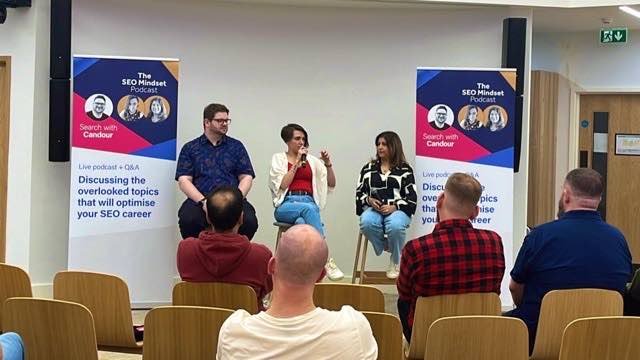

Learning and Takeaways: Practical Knowledge for Immediate Use
Several talks and workshops were incredibly impactful. Alice Rowan's presentation about creating authentic content provided actionable advice and additional resources for further reading. Another session about measuring SEO sustainability by Ellie Connor offered insights that I can immediately include in my SEO strategies.
The talk on SEO forecasting by Hannah Rogers introduced a straightforward framework, providing me with another tool to better serve my clients.
Lastly, the keynote by Professor Hannah Fry helped me better understand the importance of interpreting data on a large scale.
Impacts and Next Steps
My takeaway from this year's BrightonSEO is twofold: One, although the introduction of AI into SEO can seem overwhelming, we are all learning and adapting together. Two, the SEO community is diverse and abundant with opportunities for everyone.
In terms of next steps, my focus will be on maintaining the valuable relationships I've built and integrating the new tools and strategies I've learned into my work.
To sum up, BrightonSEO September 2023 was a comprehensive learning experience. The conference remains a crucial event for anyone in the SEO industry and is a catalyst for professional growth and meaningful connections. I’ll be back in April 2024 to find out if AI overlords have indeed taken over 😉
If you want a more hands-on look at where AI tools actually help in SEO — and where they mislead — I covered this in a dedicated session at SEO Camp Day Strasbourg earlier that year, with practical examples across hreflang, schema, and translation.
Check out my previous articles on BrightonSEO ↓
If you have questions or would like to discuss more about the future of SEO, I'm just an email away.
Fresh from BrightonSEO 2023, I dive into the conference's hottest topics from AI's growing role in SEO to the vital importance of sustainable practices and networking. Read on to discover key insights and actionable takeaways that can elevate your SEO game.