SEO and business blog
Strategic thinking on international SEO, multi-market visibility, and what it takes to actually win in a new market. For in-house teams and brand managers doing this for real.
Search with Candour feature: My Take on International SEO and Freelancing
I recently had the opportunity to join Jack Chambers-Ward on his podcast, "Search with Candour". We talked about international SEO, my freelance journey, and the diverse clients I've had the pleasure to work with.

I recently had an amazing opportunity to join Jack Chambers-Ward on his podcast, "Search with Candour". We talked for a good 44 minutes about international SEO, my freelance journey, and the diverse clients I've had the pleasure to work with. Here, I'll share some of the highlights and insights from our chat.
The Freelance Life: Authenticity and Personal Touch
In the podcast, I opened up about the realities of being a freelance SEO consultant.
“My clients get super tailored service. They get someone 100% dedicated to their own project.”
Clients get the benefit of highly personalised service, but it also means that there's only so much of 'me' to go around. It's a delicate balance, but one that’s absolutely worth it for the bespoke service I can offer.
A Diverse Clientele: More Than Just Numbers
Jack and I delved into the kinds of clients that generally seek out freelancers over larger agencies.
The diversity in my clientele—from small businesses to international companies—has been both a learning curve and a source of pride for me. This isn't just for show—it's a treasure trove of learning experiences that make me a better consultant every day.
Services Tailored for You
As we delved into the services I offer, one thing became clear: one-size-fits-all solutions don’t cut it.
“Clients come to me because I’m a freelancer, they stay with me for the personality and the expertise, but we do have to get along really well to make it work long-term.”
If that way of working resonates with you, here's a closer look at how I structure my SEO engagements.
Each client is unique, and their SEO needs are too. Whether it’s a comprehensive SEO audit or crafting a content strategy, my services are tailored to meet these individual needs.
“It’s more about making sure that the experience they get from me is top-notch, and they have their answers to all their questions, and they feel empowered to drive their strategy the way they see it fit.”
Navigating International SEO
When it comes to international SEO, it's more than just translations; it's about understanding the cultural nuances. I offer a 360º understanding of client businesses, making me equipped to handle the challenges that come with international clientele.
If your business is navigating multiple markets, this is exactly where an SEO Strategy Sprint tends to be most useful.
Listen Up! 🎧
If this has piqued your curiosity, why not listen to the full conversation? It’s packed with insights that go beyond what I’ve touched on here.
It was an enriching experience to be part of the podcast, and I hope you find these highlights as insightful as I did during the conversation. Do give the podcast a listen for the full experience and to gain a deeper understanding of my approach to SEO and consultancy.
Thanks, Jack, for having me! 😇
If reading this made you think about your own SEO situation, whether you're entering new markets or just trying to get clarity on your strategy, that's usually a good sign it's worth a conversation.
Or if you'd rather start by following along, I write about this kind of thinking in my newsletter. One email, only when it's worth your time.
Understanding and using AI for an effective international SEO strategy - A talk at the SEO Camp Day Strasbourg 2023
In February 2023, I stood in front of a room of French SEO practitioners at the first SEO Camp Day Strasbourg and asked a question the industry was dancing around: what can AI tools actually do in international SEO, and where are they performing confidence without competence?
→ Link to the slides in French 🇫🇷
In February 2023, I stood in front of a room of French SEO practitioners at the first SEO Camp Day Strasbourg and asked a question the industry was dancing around: what can AI tools actually do in international SEO, and where are they performing confidence without competence?
My audience were practitioners: curious, slightly cautious, and smart enough to spot hype. Rather than adding to the noise around ChatGPT, I tested AI against the specific demands of multi-market SEO work: tasks where language, cultural nuance, and structural precision all matter at once. What follows are the key takeaways from the session, the resources I cited with annotations, and an honest update from 2026.
What I hope people took away from the talk
AI processes patterns, not meaning, and that gap matters in international SEO. The Chinese Room thought experiment is the right frame: a person inside a room follows rules to process Chinese symbols without understanding the language. AI does the same. For international SEO, this matters because cultural nuance is meaning. Any task that requires understanding why a German-speaking audience searches differently from a French-speaking one sits outside what current AI handles reliably.
Hreflang generation is a legitimate use case. Generating hreflang tag sets from a structured input (list of URLs, language/country combinations) is exactly the kind of mechanical, pattern-based task where AI performs well. The output format is predictable, the validation rules are known, and errors are easy to catch. Use it to rough out the implementation, then verify against Google's specification before deploying.
Schema markup generation works for the same reason. FAQ schema, Product schema, LocalBusiness — these follow strict structures with defined properties. Feeding AI your question-and-answer pairs and asking for JSON-LD output cuts most of the manual work on a repetitive task. The result needs review, but the time saving is real. Always validate through Google's Rich Results Test before implementing.
Translation is unreliable, especially for anything with texture. I tested DeepL, Google Translate, and ChatGPT on the same passage of nuanced English prose. All three lost something — particularly figurative speech and culturally specific connotations. For international SEO, where keyword meaning differs across markets (French Canadian gommevs. French chewing-gum, for instance), machine translation gives linguistic proximity, not market relevance. Use it as a starting point, then have a native speaker review.
Cultural content adaptation works across large differences, not subtle ones. Asking AI to generate content ideas for a gardening blog in Finland versus Morocco produces meaningfully different outputs — climate, local customs, regional specifics come through. Asking it to adapt content between France and Belgium, or between UK and Australian English, produces near-identical results. The smaller the cultural gap, the less AI adds over just writing for the market directly.
Alt tag generation at scale is a strong use case. Danny Richman's GPT-3 alt tag generator combined the OpenAI API, EveryPixel for image analysis, and RapidAPI for orchestration. For large international sites with thousands of product images, this kind of tooling saves real time at acceptable quality. The "under the hood" slide from the talk showed the actual prompt structure — it specifies output length, excludes decorative language, and includes keyword context.
Building lightweight tools is within reach. The most practical part of the talk was showing Python and Google Apps Script in action for repetitive SEO tasks: extracting images without alt text from a Screaming Frog export, automating monthly report delivery to clients. These aren't complex — but they save time every single month and remove recurring tasks from the mental load entirely.
Resources from the talk
What is generative AI? — McKinsey This is where the working definition in the talk came from. It covers the distinction between generative models (text, image, audio, code) and more traditional AI approaches without requiring a technical background. Worth sharing with a client or marketing team trying to understand what these tools actually are before deciding whether to use them.
GPT-3 explained — Science Focus GPT-3's 175 billion parameters were the clearest illustration at the time of the scale difference between large language models and anything that came before. This article explains the architecture accessibly. The parameter count comparison in the talk (GPT-3 versus the human brain's estimated synapses) made the scope of the technology concrete in a way that pure definitions don't.
Chinese room thought experiment — Wikipedia (FR) Searle's thought experiment is the most useful conceptual frame for understanding what AI is not doing. The room processes symbols by rule without understanding their meaning — which is precisely the distinction that matters when cultural nuance is part of the work. If you want the English version, search "Chinese room Searle" — the concept is the same in any language, which is appropriate given the context.
ChatGPT for SEO — Aleyda Solis Aleyda Solis was among the first practitioners to document specific prompt patterns for SEO tasks in a structured, replicable way: hreflang generation, schema markup, meta descriptions. The examples in the hreflang and FAQ schema sections of the talk drew directly from this resource. It remains a useful starting library for anyone building their own prompt collection for technical international SEO work.
Generate alt tags with ChatGPT — Danny Richman Danny Richman built a working alt tag generator by combining the OpenAI API, EveryPixel for image recognition, and RapidAPI. The talk showed the actual prompt structure: generate a descriptive alt tag under 16 words, from image URL plus keyword context, excluding decorative language like "illustration" or "wallpaper." Worth reading if you want to understand how to replicate something similar for a client site with a large image inventory.
ChatGPT: Friend or Foe? — The Recipe for SEO Success (Kate Toon) Kate Toon's podcast episode covers the practical and strategic questions around AI in SEO from the perspective of a grounded generalist practitioner — a useful counterweight to the breathless coverage that was everywhere in early 2023. Kate later invited me onto the show to discuss SEO longevity, which you can listen to here.
My take in 2026
The core argument holds: AI handles structured, rule-based international SEO tasks well and breaks down where cultural understanding is required. What has shifted is the baseline. Models are far stronger now, real-time web access has resolved the "no recent data" limitation for most tasks, and the barriers to building lightweight tools have dropped considerably — what required a Python script and an API key in 2023 takes ten minutes in a tool like Claude Artifacts. The toolbox has expanded significantly. What hasn't changed: AI still doesn't understand why German users search differently from French ones, or why the same product concept needs completely different framing in Quebec versus Paris. That judgment still sits with the practitioner.
What’s the future of SEO? - Panel discussion at the Erepday 2022 conference
I had the privilege of participating in the panel discussion “What’s the future of SEO?” at the 2022 Erepday conference in Strasbourg alongside two other SEO experts. Find out more about my experience at this amazing event.
I had the privilege of being invited to participate in the panel discussion “What’s the future of SEO?” at the 2022 Erepday conference in Strasbourg alongside two other SEO experts: Dan Bernier and Mickaël Hamard.
The Erepday conference brings together the essential news of the “hot” topics of e-reputation, branding and customer relations 2.0. It is an exceptional day of conferences, panels and networking with expert speakers in the field of the web and e-reputation to grow your brand and business. It’s organised by the amazing teams at Blue Boat.
So, what’s the future of SEO?
On the panel discussion, we discussed what SEO will look like in 10 years. My take on this was that it will remain fun and exciting, and I am positive that SEO will be around for the foreseeable future. I also believe the emphasis will be put on inclusivity and accessibility on the web.
We can't predict exactly what will happen in SEO over the next 10 years, but we know Google's global vision is to make internet information available to everyone. That shouldn't change much.
By working on making information available to people all around the world, Google is setting the stage for a new era of digital knowledge, where information is made accessible to everyone, regardless of their location, language, device or background.
We had conversations around the evolution of the SERP, especially how Google was bringing sensorial elements to the SERP. We also discussed the importance of authenticity, the need to remain true to oneself, and the concept of staying true to one's values even when the world around us changes. We discuss how the future of online search will be spread across multiple platforms, and how this will create a shift in the way we access information. We explore the implications for businesses, as well as the importance of finding ways to remain relevant in this ever-evolving landscape. Additionally, we consider the impact on people's lives and how our approach to information gathering will be shaped by the resources available to us.
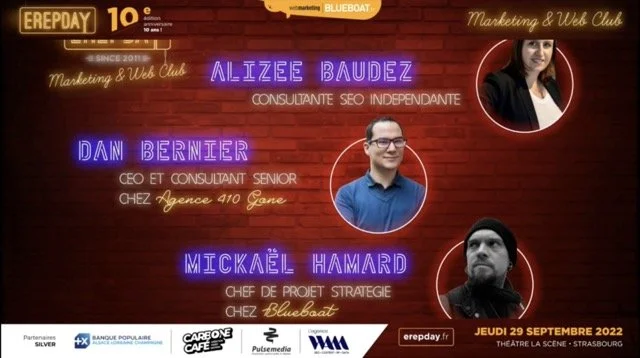
The video is only in French, but the transcript can be translated to English 🙂
I thoroughly enjoyed my experience at the 2022 Erepday conference in Strasbourg and I am thankful to the organisers for inviting me to be a part of the panel. It was great to be able to share my insights and knowledge with the other experts and attendees.
I am confident that SEO will continue to evolve and become even more important in the future, and I am looking forward to seeing what the future has in store for the industry.
Podcast: SEO Strategies that stand the test of time - Recipe for SEO Success
I was invited on The Recipe for SEO Success, Kate Toon’s famous podcast, to talk about longevity in SEO. 🎙 Listen to the episode!
In August 2022, Kate Toon invited me onto The Recipe for SEO Success, Kate Toon’s famous podcast, to talk about longevity in SEO, why a solid strategy outlasts algorithm updates, and how to resist the pull of constant reactivity. The conversation ran 44 minutes. I'm still giving the same core answers today.
Kate's audience is primarily English-speaking small business owners, solopreneurs, and digital marketing practitioners: people building their own SEO rather than delegating it to an agency. The questions she brought were the right ones, not how to chase rankings, but how to build something that holds.
What came out of the conversation
The philosophy behind search hasn't changed — that's your anchor. Google's core objective has stayed constant since day one: deliver the most useful answer to any given question. Every algorithm update, from Hummingbird to BERT to the Helpful Content rollout, has been an attempt to close the gap between what Google returns and what users actually need. The implication is straightforward: build for the user first, and algorithm changes improve your position over time rather than destabilising it.
SEO doesn't change. It evolves. In the conversation, I described it like a child growing up — you're still the same person you were at seven, but more capable and more complex. The fundamentals of quality, relevance, and authority haven't been replaced. They've been refined. The businesses that treat algorithm updates as disruptions tend to be the ones who were gaming rather than building.
Three to six months is the honest minimum. Anyone promising results faster is selling something. For established sites that are already technically sound, results can take longer because you're in the compounding authority stage rather than making quick gains. The worse the starting point, counterintuitively, the faster some early results arrive — a site loading in 22 seconds that you bring to three will climb almost immediately. But if you're already well-optimised and working on authority, patience is the strategy. This is also why every SEO Strategy Sprint I run starts with an honest assessment of the site's starting point before setting any timeline expectations.
Keyword strategy needs two review triggers, not one. The first is business change: a new product line, a pivot, a new audience segment, any shift in what you offer should prompt a keyword audit. The second is calendar-based: every six to twelve months, open the spreadsheet and check it against Google Search Console. See if your users' actual searches still match your keyword assumptions. Often they don't, and the gap is where you're losing traffic you should be winning.
When a competitor climbs above you, do nothing immediately. Google sometimes rewards newness as a temporary experiment. A site with little authority and thin content can spike and fall back within weeks. The reactive move — changing your own strategy in response to a blip — is often the wrong one. Watch the competitor for two to three months before treating the shift as permanent.
A featured snippet today might win you a client in a year. SEO outcomes and business outcomes operate on different clocks. A ranking position doesn't convert immediately; it builds visibility over time, and the actual business impact arrives later. The businesses that stop before the flywheel gets going are the ones that never see the return on what they already invested.

Listen on Apple Podcasts ↓
Listen on Spotify ↓
“I highly recommend that you follow Alizée. She just approaches SEO with a real enthusiasm, positivity, and a human touch, which I think is very much aligned with how I approach it.”
Huge thanks to Kate for inviting me on the podcast! 🥰 I had a great time!
The episode is from July 2022. Kate Toon is one of Australia's most respected SEO educators and the host of The Recipe for SEO Success podcast, which she has run since 2016.
Round Table: French Technical SEO - the SEO Kitchen Show by Oncrawl
Watch the replay of the roundtable on French Technical SEO at the SEO Kitchen Show by Oncrawl!
I was kindly invited by the Oncrawl teams to participate in The SEO Kitchen Show’s first roundtable about French technical SEO. The SEO Kitchen Show is a series of webinars that were run over the course of 3 days in June 2022.
The goal was to share our expertise and have the audience benefit from it. We got to debate on various topics related to French technical SEO with my colleagues Véronique Duong, Julien Deneuville, Emmanuel de Vauxmoret and Rebecca Berbel to try and sort out the best French technical SEO recipe.
Topics we talked about include:
What is technical SEO and how it’s different from “regular” SEO
How technical SEO is important and what is its role in an SEO strategy
What are the hot trends in technical SEO right now and which subjects could be more highlighted
Technical SEO tools
This particular roundtable was in French, but you can switch on translated subtitles if you want the English version.
Other topics were discussed in English and included:
SEO automation
Enterprise and strategy
Agency SEO
Search intent
Algorithm updates
Content and technical SEO
E-commerce
Data science
I highly recommend you check out the other round tables where a lot of people I deeply admire in the industry gave their best advice.You can watch/binge watch all the replays for free!
Bonus → The SEO Kitchen Show created a cookbook with all our best recipes! 👩🏻🍳🥘
Twitter takeover: Use Search Intent to Optimise Product Pages - Semrush #SEOThread
I got to take over the Semrush #SEOThread on Twitter! I chose to write about using search intent for product pages. I’ve detailed here some key points and added relevant links.
The Semrush team got in touch with me a few weeks ago to do a #SEOThread on their Twitter account. I chose to write about using search intent to optimise product pages for e-commerce. You can read the whole thread below. ↓
Hello SEO friends! 👋 I'm Alizée, a freelance SEO consultant with a passion for specialty coffee and knitting.
— Semrush (@semrush) June 14, 2022
I'll be taking over the #SEOthread today to talk about using #searchintent to optimise product pages 🤓
So get cozy, grab a notepad, and read on! 😉↓ @AlizeeBaudez pic.twitter.com/w7iyHbK6X2
In a nutshell, here are the few elements I mentioned in this #SEOThread.
What is Search intent?
First things first, search intent is the purpose of a user’s search.
— Semrush (@semrush) June 14, 2022
There are 4 type of search intent:
→ Navigational = find something or a website
→ Informational = research
→ Commercial = compare options
→ Transactional = buy, complete an action#SEOthread @AlizeeBaudez pic.twitter.com/l25vgdiJxB

In a way, informational, commercial and transactional search intents coincide with the buyer’s journey. The general idea here is that you want to take your user through each step of the journey with the content you put on your website.
Where does the product page fit?
The product page can be visited by the user at any stage of the process (=any stage of the buyer’s journey). But at the end of the day, its goal is to sell. So you want to optimise your product page for the decision stage, with keywords that have a transactional search intent.
How to optimise your product page for transactional queries?
How to optimise your product page for transactional queries?
— Semrush (@semrush) June 14, 2022
1️⃣ Check out what queries the page is already ranking for on Google Search Console
2️⃣ Extend your keyword research to transactional queries
3️⃣ Implement optimisations#SEOthread @AlizeeBaudez
1 - On Google Search Console
Look at the keywords that drive traffic to your product page. Read through them carefully. Can you already spot what type of search intent is emerging from those keywords?
Export the keyword and define a search intent for each of them. You can use a spreadsheet or a keyword analysis tool.
How to easily spot a transactional keyword?
— Semrush (@semrush) June 14, 2022
Look out for the words “buy”, “for sale”, “price”, “cost”, “supplier”, “quote”, etc.#SEOthread @AlizeeBaudez pic.twitter.com/19YyEwRE9V

2 - Extend your keyword research to transactional queries
Now you have deciphered what brings your users to your product page, it's time to adjust and broaden your horizons! We'll do this by doing a bit of keyword research, just to make sure what we're changing is in line with what our users need.
I often use the Semrush Keyword Magic Tool to find related queries and filter the results by search intent, keeping only the transactional ones.
— Semrush (@semrush) June 14, 2022
Pick a few of the best ones according to your usual keyword research criteria.#SEOthread @AlizeeBaudez pic.twitter.com/9ogMu9yiTl
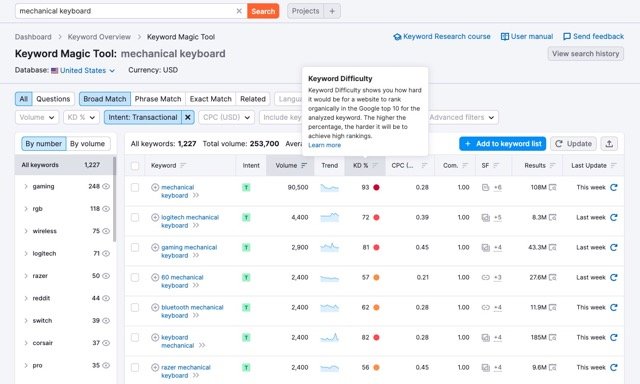
3 - Implement your transactional keywords where it matters the most
Make sure the keywords you end up with are in the page title, the meta description, the headings of the page. Include them in bold in your paragraphs, optimise your copy in the best way possible.
Extra elements to consider on your product page
💡 Extra elements to consider on your product page:
— Semrush (@semrush) June 14, 2022
→ Have a clear CTA for your product
→ Keep the page design simple and effective
→ Go to the point in your copy
→ Include reassurance elements (reviews, payment options, delivery, use cases...)#SEOthread @AlizeeBaudez
If you need any help with your product page, your e-commerce website, or if you want to optimise your keywords for the right search intent, get in touch with me today!