SEO and business blog
Strategic thinking on international SEO, multi-market visibility, and what it takes to actually win in a new market. For in-house teams and brand managers doing this for real.
AI Overviews launched in France. Here's what the markets that went first already know.
Roughly 40% of AI Overview citations come from pages outside the organic top 10. Ranking first no longer protects you. What the markets that went before France already know, and what to do this week.
Update — 07 September 2026: the full guide is live. This piece stays as the launch-day snapshot (July 22); for the France-specific post-launch data (confirmed trigger rate, citation concentration, publisher response), get the full guide below. This is also what resolves, visibly, the three questions the piece ended on.
Cette note est disponible en français → Télécharger le PDF “AI Overviews en France : ce qui vient de changer”
The essentials
Google launched AI Overviews and AI Mode in France on 22 July, two months ahead of the ceiling it gave publishers and without a signed remuneration agreement.
Published impact studies range from -15% to -65% on click-through, because they measure different things. Risk concentrates on informational queries, not on industries.
Roughly 40% of AI Overview citations in Italy come from pages outside the organic top 10. Ranking first no longer protects you, and not ranking first no longer excludes you.
One action is urgent this week: export your Search Console baseline before the pre-launch period slides out of the 16-month window.
What happened this morning
At 7am, Google launched AI Overviews and AI Mode in France. Both at once, desktop and mobile, rolling out progressively over the coming days.
France was the last major market without them. Not for technical reasons, the feature has run in French in Belgium and Switzerland since March 2025. The block was legal, tied to France's neighbouring rights regime, which obliges platforms to pay publishers for reusing their content.
That block just gave way, and it gave way without an agreement.
On 29 June, Google wrote privately to French press editors announcing a launch "no later than 23 September." The letter was revealed by Ouest-France and confirmed by Les Échos and Le Monde. Everyone read that date as the plan. It was a ceiling.
The official announcement came from Sébastien Missoffe, Google France's managing director, and calls it a major milestone. French publishers called it a fait accompli.
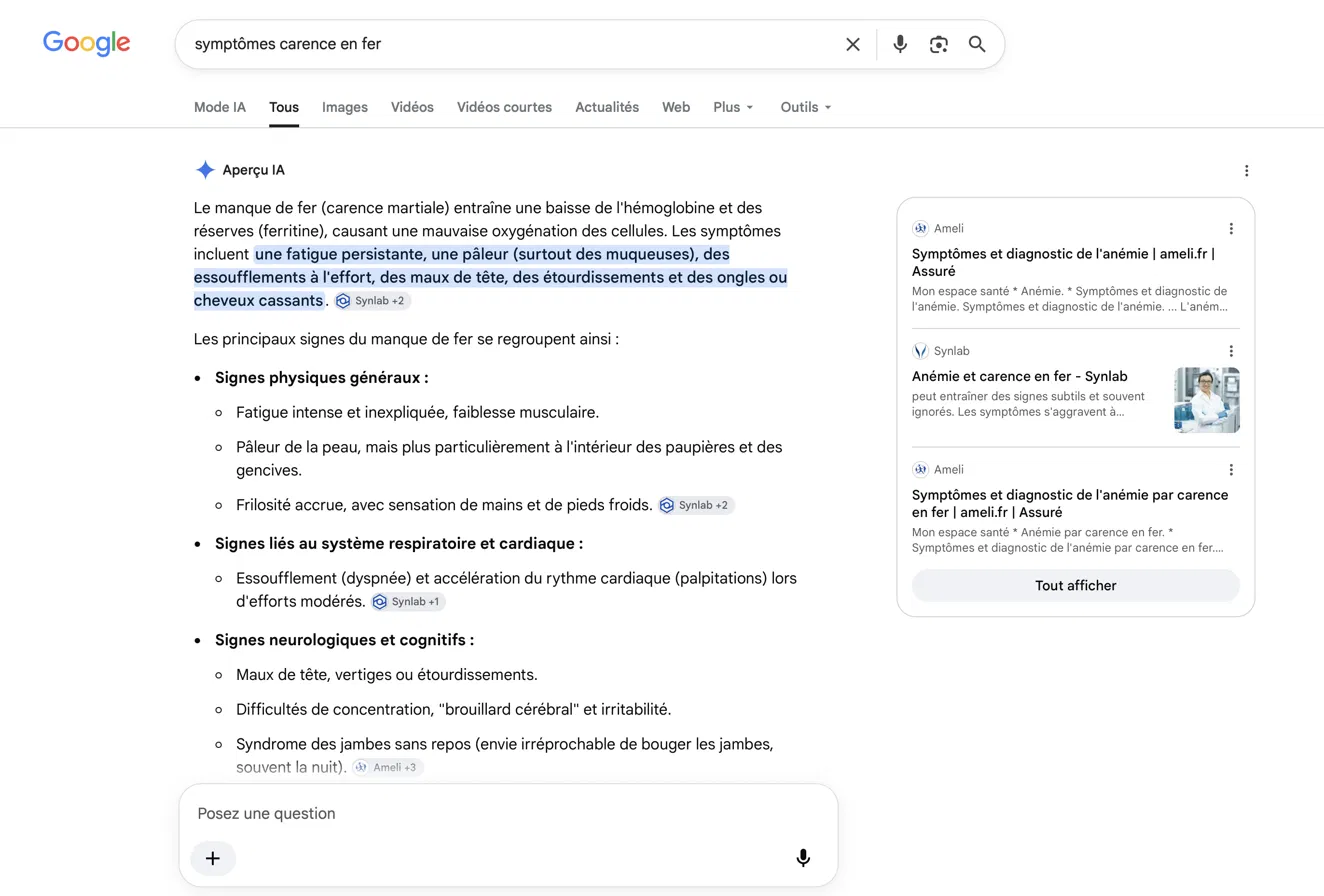
AI Overview on google.fr, “symptômes carence en fer”, captured 22 July 2026.
Why this matters beyond France
If you run search in more than one market, the French launch is the last data point in a two-year natural experiment.
Every major market has now crossed the same line, at different speeds, under different conditions. The US got the feature in May 2024 and watched it fail publicly. Nine European markets followed in March 2025. AI Mode reached 40 countries in October 2025, with France carved out. Now France, two months ahead of a schedule Google itself set.
What this means practically: there is no market left where "wait and see what happens elsewhere" is a strategy. The elsewhere is gone. Everyone is now downstream of the same mechanism, and the only variable left is what share of your traffic sits in the exposed category.
That variable turns out to matter enormously.
What the data actually shows
Not a single number. A range, and the range has a structure.
| Study | Market | Sample | What's measured | Result |
|---|---|---|---|---|
| SISTRIX | Germany | 100M+ keywords | Position-1 CTR with AI Overview | 27% → 11% |
| Ahrefs | Global | 300,000 keywords | Position-1 CTR with AI Overview | -58% |
| Pew Research | US | 68,879 searches | Click on a traditional result | 8% vs 15% |
| Seer Interactive | US | 3,119 queries | Organic CTR, informational | 1.76% → 0.61% |
| SEOZoom | Italy | ~30M keywords | Trigger rate | 54.15% |
Germany → SISTRIX analysed over 100 million German keywords. When an AI Overview appears, click-through at position one falls from 27% to 11%. Across the market, that's 265 million organic clicks lost per month. Johannes Beus, who founded SISTRIX, put it plainly: that traffic isn't coming back.
Global → Ahrefs, across 300,000 keywords: a 58% drop in position-one CTR when an AI Overview is present. In April 2025, the same measurement showed 34.5%. It worsened by two thirds in eight months.
United States → Pew Research Center tracked 900 people across nearly 69,000 searches. With an AI summary present, users clicked a traditional result 8% of the time. Without one, 15%.
Italy → SEOZoom analysed close to 30 million Italian keywords. AI Overviews trigger on 54.15% of searches. Of 168 million visible domains in Italy, the algorithm draws on 175,000 — one tenth of one percent. And roughly 40% of cited links come from URLs that don't rank in the organic top 10 for that query.
Concentration → Ahrefs, across 55.8 million AI Overviews: the top 50 domains capture 28.9% of all mentions.
These figures span -15% to -65% depending on the study. That isn't a contradiction. They measure different objects — browsing behaviour, keyword-level CTR, brand Search Console time series. Anyone citing one number as the answer is either selling something or hasn't read the methodology sections.
The finding that should change your planning
Forty percent of Italian AI Overview citations come from pages outside the organic top 10.
Ranking first does not protect you. Not ranking first no longer excludes you. The two hierarchies do not map onto each other, and most organisations are still managing the first one exclusively.
This is the single most actionable finding in the current data, and it's the one that gets least attention, because it doesn't fit the story either side wants to tell. It isn't a catastrophe narrative and it isn't reassurance. It's a structural change in how visibility is allocated.
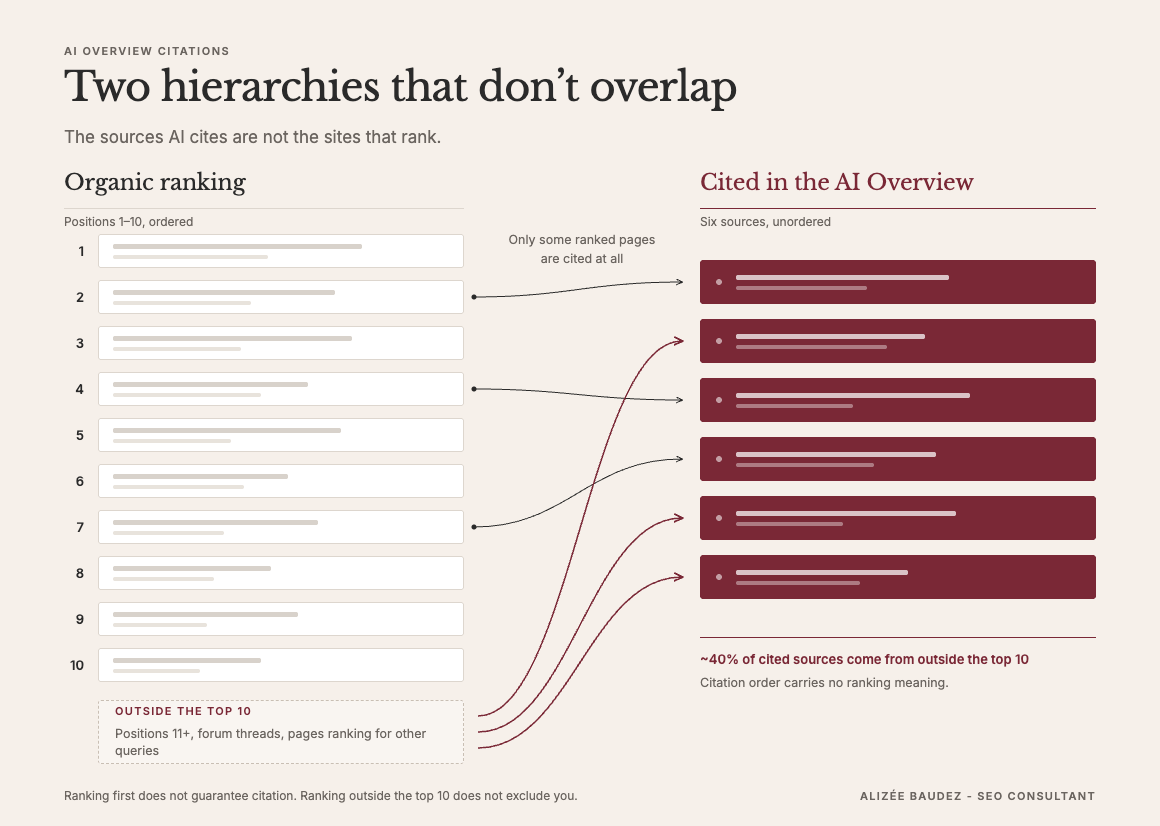
Left: organic ranking, positions 1–10. Right: sources cited in the AI Overview. Roughly 40% of citations come from outside the top 10.
Where the risk concentrates
Sector exposure varies more than most coverage suggests.
In Italy: health at 40.3% coverage, finance at 20.2%, family and community at 19.9%. At the other end, general retail at 4.3%, travel and tourism at 6.4%, sport and fitness at 6.4%. Ahrefs finds the same hierarchy in US data, with health and wellbeing at 43%.
The logic is readable. Google intervenes where a wrong answer causes harm, and holds back where its advertising model is exposed. If you sell, you're spared for now. If you explain, you're exposed.
Which means your risk isn't determined by your industry in the abstract. It's determined by what share of your organic traffic comes from people trying to understand something rather than buy something.
That's a number you can calculate on your own data this week.
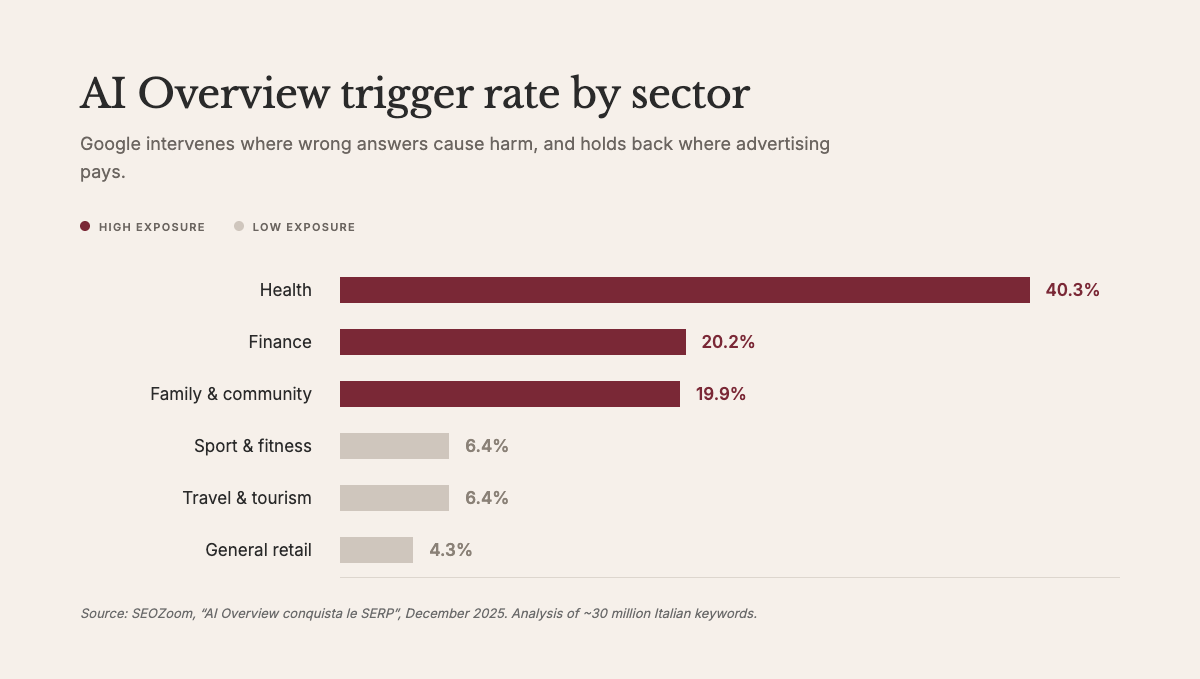
AI Overview trigger rate by sector, Italy, December 2025.
What France reveals about regulatory protection
Here's the part with implications beyond search.
France had the strictest publisher protection in Europe. Two competition authority fines — €500 million in 2021, €250 million in 2024. An active framework agreement covering roughly 450 publications. Ongoing negotiations. A commitment in writing, dated 29 June, naming September.
Google launched in July, during the French summer holidays, without a signed remuneration agreement, two months ahead of its own stated ceiling.
The CPA, GESTE and SPIIL — three French digital publishing and marketing bodies — issued a joint statement criticising the timing and announcing graduated responses. As of today, no legal action has been filed.
If you were counting on regulatory friction to buy you preparation time in any market, this week is the data point that should update that assumption. The strictest regime in Europe produced a two-year delay and then folded on a Wednesday morning in July.
What France gained, and what it lost
Every market that went before France got the rough draft.
Google launched in the US in May 2024, watched its AI recommend putting glue on pizza, and pulled back within a fortnight. Then spent two years restricting, patching, expanding, retreating — in public. Those two years functioned as a visible warning for American, British and German site owners. They watched it arrive slowly enough to react.
France got the finished product. No observation phase, no gradual ramp during which anyone adjusts. Same mechanism, higher step.
What France did gain is two years of data produced by other people. Germany, Italy, Spain and the UK have already measured what happens. Those numbers are public and they constitute a map the pioneer markets never had.
The delay was never a reprieve. It was an information advantage, for anyone who used it. It expired this week.
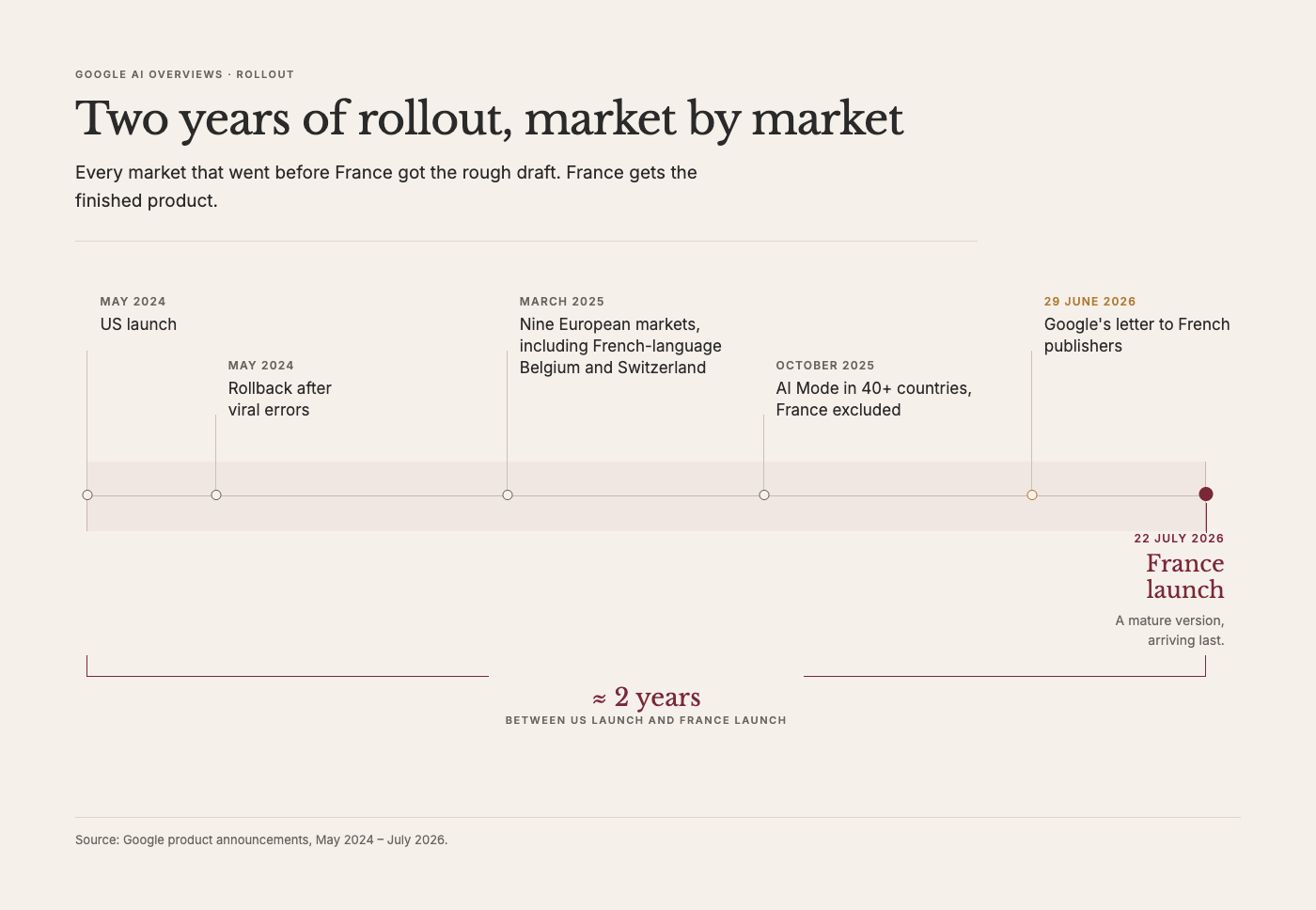
Two years separate the US launch (May 2024) from the France launch (July 2026).
What to do now
For anyone with French traffic, one action is genuinely urgent this week. The rest can wait.
1. Capture your Search Console baseline
Search Console holds a rolling 16-month window. Your pre-22-July data isn't gone today, but it will slide out of that window over the coming months. If you don't export it, it becomes unrecoverable — barring an external backup like BigQuery, which most organisations don't have.
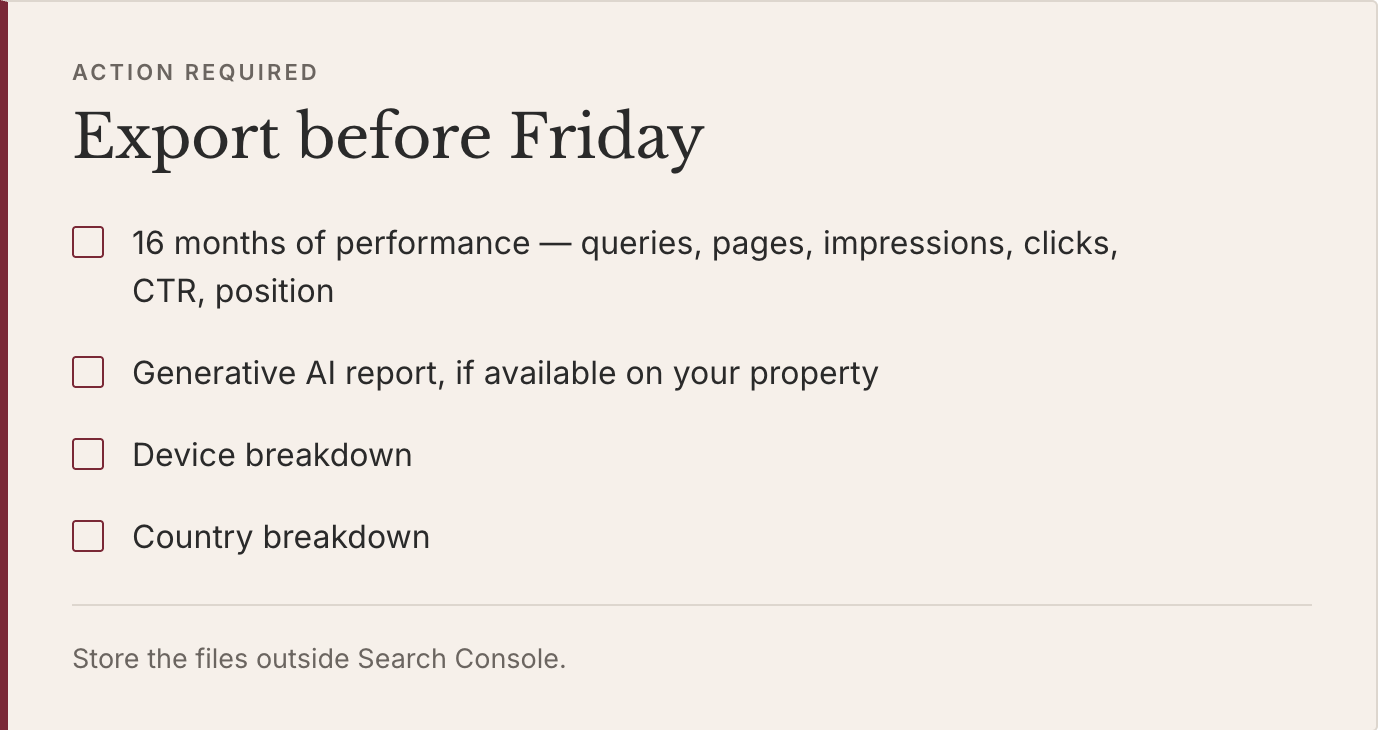
Export this week:
16 months of performance: queries, pages, impressions, clicks, CTR, average position
The Generative AI report, if available on your property
Device and country breakdowns
Store the files outside Search Console.
In October, someone senior will ask whether a traffic decline is AI or execution. Without this baseline, that question has no clean answer.
2. Segment traffic by intent
Calculate what share of your organic traffic comes from informational queries. Above 30%, your exposure is real and you should act in September. Below 10%, observe.
This takes half a day and it determines everything else.
3. Watch the impressions-to-clicks gap
Stable impressions with falling clicks means you're being cited and nobody is clicking through. This decoupling is the first symptom observed in every market. Track it page by page, not at site level.
What not to do
Don't extrapolate German numbers directly. Different query mix, different publishing landscape, 16 months of divergence. Those figures give you a range of scenarios, not a forecast.
Don't opt out reflexively.Seer Interactive data shows brands cited in an AI Overview get 35% more organic clicks than those that aren't. The opt-out is domain-level, not page-level, and granular control isn't scheduled until March 2027. It's a genuine trade-off, not an obvious protective measure.
Don't restructure content this month. The rollout is progressive. Seeing AI Overviews on some queries and not others in July is expected. Wait for three or four weeks of French data before making structural decisions.
What the French data confirmed
The guide below answers the three things I was watching in July:
France's trigger rate: 52.63% (SE Ranking, 100,000 keywords) — landing between Germany (~20%) and Italy (54.15%). [Who gets cited — your finding] [What publishers did — your finding]. Full breakdown, including the transborder section, in the guide →
Citation is highly concentrated: 9 domains capture 25% of all citations. YouTube appears in 1 in 2 AI Overviews. French-language content is cited 89.34% of the time.
What publishers did: APIG filed a formal complaint with France's competition authority. The Autorité de la concurrence's Meta ruling is the likely template for resolution.
The full breakdown, including the transborder section, in the guide →
Working on French market visibility? Get in touch!
Download Your Guide to AI Overviews in France
This free guide is built for international marketing and SEO leads with a presence in France who need to know if this changes their numbers, and agencies advising French or France-facing clients this quarter. Contains France-specific post-launch data and a cross-market comparison (Germany, Italy, Spain, US).

Sources
Launch and official communication
Google France — Lancement des Aperçus IA et du Mode IA en France (Sébastien Missoffe, 22 July 2026)
Abondance — Google lance officiellement les AI Overviews en France
Blog du Modérateur — Google déploie AI Overviews et AI Mode en France
Publisher response
Journal du Net — Google lance AI Overviews en France sans concertation avec les éditeurs de presse
Archimag — Google déploie AI Overview en France et engage un bras de fer avec les éditeurs de presse
Impact data — markets that launched first
SISTRIX — AI Overviews in Germany (Johannes Beus, 100M+ keywords)
PPC Land — AI Overviews cost Germany 265M organic clicks monthly
Ahrefs — AI Overviews Reduce Clicks by 58% (300,000 keywords)
Ahrefs — AI Overviews Reduce Clicks by 34.5% (original study)
Pew Research Center — Do people click on links in Google AI summaries? (900 people, 68,879 searches)
Seer Interactive — AIO Impact on Google CTR (3,119 queries, 42 organisations)
SEOZoom — AI Overview conquista le SERP (Gennaro Mancini, December 2025, ~30M Italian keywords)
Tools and mechanics
How Lipton Teas & Infusions built US search visibility from Scratch, and what it required
A corporate rebrand, four audiences, and a brand name dominated by a competitor. How the architecture decisions made before launch determined every result that followed.
The Lipton name gets searched thousands of times a month in the United States. Nearly all of those searches are about iced tea. Almost none of them are about the FMCG group that owns Pukka, PG Tips, Tazo, and T2.
When Ekaterra rebranded as Lipton Teas & Infusions and launched a new corporate site from zero, this was the problem waiting at the other end of any standard SEO approach: rank for "Lipton" and you drown in irrelevant traffic from consumers who want cold drinks. Avoid it entirely and you have no anchor for the brand at all.
The brief was clear. US market. Employer brand visibility. Zero organic baseline. Getting the architecture wrong before launch would mean spending the next two years undoing it.
The situation
The new site, liptonteas.com, needed to serve four completely different audiences: job candidates searching for careers in the US, press and analysts researching the group, retail and distribution partners, and investors. Each audience had different search intent. Content built for one would actively work against the others if the URL structure and content architecture weren't designed to separate them before a single page went live.
The cannibalisation risk was real. The group's product brands — Pukka, T2, Tazo, PG Tips — each have their own websites and their own SEO strategies. A poorly designed corporate site would bleed equity into the wrong places and confuse search engines about which brand owned which audience. And the former parent company, Unilever, still carried strong search association with the Lipton name. The brand confusion wasn't a marketing problem. It was a structural one.
What determined the outcome
No keyword work started until the competitive landscape was mapped. Which FMCG groups were competing for the same US talent pool? What benefits and values were they communicating? Where were they winning, and where were the gaps?
Lipton Teas & Infusions already had genuine strengths — a serious sustainability commitment, strong diversity, equity and inclusion practices, competitive benefits. But without knowing how competitors were positioning those same attributes, any content strategy would have been generic rather than deliberate.
The keyword research came second, built from scratch for the US market. Not adapted from a European strategy. Not translated from another language. Each of the four audience segments got its own research layer: careers queries by job title and US geography, investor and analyst search patterns, wholesale and distribution queries for retail partners, press and research behaviour from journalists. And critically, a defined set of queries was explicitly excluded from the strategy — consumer product searches, iced tea queries, customer service topics — to protect every relevant visit from day one.
The architecture and content recommendations came last, grounded in that research. URL structure, content pillars, internal linking logic, and page-by-page intent mapping were all finalised before the site launched.
What happened
The site launched in July 2023. By January 2024, it had reached 7,900 monthly organic visits worldwide. Every primary employer brand query in the US ranked number one — "lipton careers," "lipton tea jobs," "lipton tea employment" — all from a standing start, with no paid traffic. The architecture held: no cannibalisation with the product brand websites was observed across the group's entire search footprint.
The traffic the site attracted was the traffic it was built for. That is not a given.
Three things this project made clear
Architecture decisions made before launch determine the results. Retrofitting SEO to a live site is harder, slower, and more expensive than designing the structure correctly from the start. The URL decisions, content pillars, and audience segmentation choices made before a single URL was published determined what was possible in the first five months.
On a high-stakes launch — a rebrand, a new market entry, a corporate site serving multiple audiences — SEO strategy is not something you add to the project plan after design is approved. It is an input to design.
US keyword research is not a translation of a European strategy. Search behaviour for employer brand queries differs significantly between markets, not just in language, but in the topics that matter, the values that influence candidate decisions, the specific vocabulary around DEI and remote work that US candidates actually use. A strategy built from the US market upward, rather than adapted from somewhere else, generates relevant traffic rather than technically correct traffic.
Knowing which queries to exclude is as important as knowing which to target. For any brand operating in a complex ecosystem — multiple subsidiaries, shared naming with another company, a history under a different parent — the discipline of deciding what you will not rank for protects the entire content investment. Every exclusion decision in this strategy was a budget protection call, not just an SEO one.
Is any of this relevant to your situation?
This project was a launch. But the same principles apply to any brand navigating a rebrand, a new market entry, or a corporate site trying to serve multiple audiences without confusing all of them.
If you are about to launch something and haven't yet decided the architecture, that decision is costing you more each week it's deferred. If you've already launched and the traffic doesn't reflect the audiences you need, the work is recoverable, but the earlier it starts, the less you undo.
The full case study presentation — including keyword rankings, traffic data, and the complete strategic approach — is available to download here.
If you're working on a project with similar constraints, a short assessment call is the fastest way to find out whether my approach fits what you're trying to solve.
Picture perfect! 📸 Increasing relevant traffic for an independent photographer
In this case study, we delve into Clément Renaut's SEO journey as an independent photographer based in Alsace, France. We addressed critical technical errors, transitioning HTTP images to HTTPS and restructuring the website for enhanced user experience. By aligning content with Clément's services and preferred locations, organic traffic related to weddings and family photography nearly doubled and tripled, respectively, over six months. Local visibility in key areas, such as Strasbourg, significantly improved, resulting in higher average positions and click-through rates. This case study showcases the transformative impact of tailored SEO strategies on driving relevant traffic and enhancing online visibility for independent professionals.
Clément Renaut is an independent photographer based in Alsace, France. His unique personality brings the best out of people in a joyful and fun way. He mainly does wedding photography, individual and family portraits. His area of work is in Alsace-Lorraine regions. Photography is a very competitive industry and Clément made many adjustments to his website through the years.

Where we started
Lack of visibility on keywords important for the business
The top keywords for which the website ranked where focused around topics of secondary importance for the business, such as wedding venues, or general informational content about wedding organisation that was not likely to bring in conversions.
Confusion to where the business operates
The website also ranked for cities far away from where Clément operates. Despite his ability to move around in France for photo shoots, most of his revenue is made in a 150 km area around his home.
A mix of HTTP and HTTPS content
Years of updates to this custom-built website have created errors, especially regarding the location of the images. A hole bunch of them were stored on a HTTP repository, triggering mixed content errors.
Goals of the project
Our first goal was to improve the general health of the website, removing critical technical errors that were seen as a red flag by search engine crawlers. Then we would work on improving relevant organic traffic for the website. That means making sure the keywords we would target were:
In line with what his clients are searching for
Relevant to the photography services Clément offers
Local to his area
What we did
Moving HTTP images to HTTPS
Thankfully, Clément has a background in IT and was able to make all the right changes and redirections super fast.
On another note, there is something deeply satisfying to seeing error numbers go down!
There’s something deeply satisfying when you get that kind of graph @semrush 😁
— Alizée Baudez 💫 (@AlizeeBaudez) October 12, 2021
For context, this client is alone in his business, has no team nor developer. He’s a father of 3 doing his best.
I’m so proud and can’t wait to see the impact this will have for him 🥳 pic.twitter.com/8U6YgIrPl5
Reviewing the website structure
We created content clusters around his services and the locations he often visits for photo shoots. The idea was to make sure users (and bots) could easily understand what he does and where he works with an efficient internal linking strategy.
Improve content with relevant keywords
With the help of an extensive keyword research, we worked on improving the on-page content with keywords that were more relevant to Clément’s audience and aligned with their intents.
The results
Website health
With a few technical adjustments, we were able to drastically improve the website’s overall health and decrease the likelihood of Google bot crawling issues.
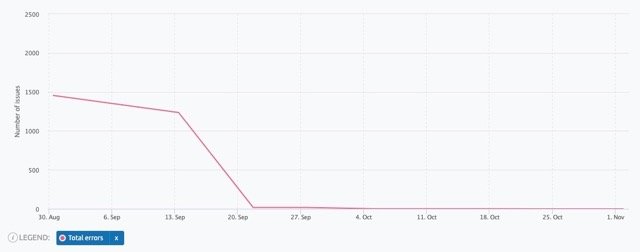
The number of critical technical SEO errors on the website went from 1454 to just 2 in a few days! 🥳

The overall website health improved by 15 points with a few technical adjustments.
Increased organic traffic on relevant keywords
For keywords relevant to Clément’s services, the organic traffic grew substantially over the past 6 months. In the examples below, the focus is on keywords that include “wedding” and “family” which are the biggest sources of revenue for this business.

Organic traffic related to weddings nearly doubled. This could be partly due to the current circumstances, but also to the increased CTR and average position of the website on these queries.

Organic traffic related to families tripled over the past 6 months and the CTR grew by 1 point. The website on those queries also ranked more than 13 places higher than before!
Increased Local organic visibility
When it comes to local organic visibility, the website performed much better. The example below if for keywords including “Strasbourg”, the biggest town in Clément’s area.

For keywords including the location “Strasbourg”, the average position of the website increased by 4 ranks, the CTR increased by 2 points, and the number of clics was doubled.
Client feedback on this project
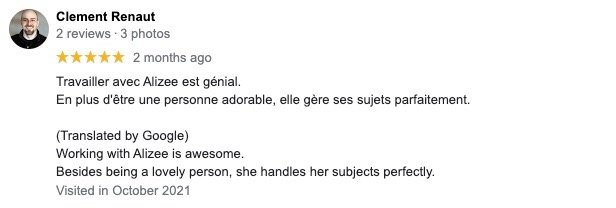
“Working with Alizee is awesome. Besides being a lovely person, she handles her subjects perfectly.”
If you found this case study interesting and would like to enquire about SEO services, you can contact me here: