SEO and business blog
Strategic thinking on international SEO, multi-market visibility, and what it takes to actually win in a new market. For in-house teams and brand managers doing this for real.
Podcast: SEO Strategies that stand the test of time - Recipe for SEO Success
I was invited on The Recipe for SEO Success, Kate Toon’s famous podcast, to talk about longevity in SEO. 🎙 Listen to the episode!
In August 2022, Kate Toon invited me onto The Recipe for SEO Success, Kate Toon’s famous podcast, to talk about longevity in SEO, why a solid strategy outlasts algorithm updates, and how to resist the pull of constant reactivity. The conversation ran 44 minutes. I'm still giving the same core answers today.
Kate's audience is primarily English-speaking small business owners, solopreneurs, and digital marketing practitioners: people building their own SEO rather than delegating it to an agency. The questions she brought were the right ones, not how to chase rankings, but how to build something that holds.
What came out of the conversation
The philosophy behind search hasn't changed — that's your anchor. Google's core objective has stayed constant since day one: deliver the most useful answer to any given question. Every algorithm update, from Hummingbird to BERT to the Helpful Content rollout, has been an attempt to close the gap between what Google returns and what users actually need. The implication is straightforward: build for the user first, and algorithm changes improve your position over time rather than destabilising it.
SEO doesn't change. It evolves. In the conversation, I described it like a child growing up — you're still the same person you were at seven, but more capable and more complex. The fundamentals of quality, relevance, and authority haven't been replaced. They've been refined. The businesses that treat algorithm updates as disruptions tend to be the ones who were gaming rather than building.
Three to six months is the honest minimum. Anyone promising results faster is selling something. For established sites that are already technically sound, results can take longer because you're in the compounding authority stage rather than making quick gains. The worse the starting point, counterintuitively, the faster some early results arrive — a site loading in 22 seconds that you bring to three will climb almost immediately. But if you're already well-optimised and working on authority, patience is the strategy. This is also why every SEO Strategy Sprint I run starts with an honest assessment of the site's starting point before setting any timeline expectations.
Keyword strategy needs two review triggers, not one. The first is business change: a new product line, a pivot, a new audience segment, any shift in what you offer should prompt a keyword audit. The second is calendar-based: every six to twelve months, open the spreadsheet and check it against Google Search Console. See if your users' actual searches still match your keyword assumptions. Often they don't, and the gap is where you're losing traffic you should be winning.
When a competitor climbs above you, do nothing immediately. Google sometimes rewards newness as a temporary experiment. A site with little authority and thin content can spike and fall back within weeks. The reactive move — changing your own strategy in response to a blip — is often the wrong one. Watch the competitor for two to three months before treating the shift as permanent.
A featured snippet today might win you a client in a year. SEO outcomes and business outcomes operate on different clocks. A ranking position doesn't convert immediately; it builds visibility over time, and the actual business impact arrives later. The businesses that stop before the flywheel gets going are the ones that never see the return on what they already invested.

Listen on Apple Podcasts ↓
Listen on Spotify ↓
“I highly recommend that you follow Alizée. She just approaches SEO with a real enthusiasm, positivity, and a human touch, which I think is very much aligned with how I approach it.”
Huge thanks to Kate for inviting me on the podcast! 🥰 I had a great time!
The episode is from July 2022. Kate Toon is one of Australia's most respected SEO educators and the host of The Recipe for SEO Success podcast, which she has run since 2016.
Round Table: French Technical SEO - the SEO Kitchen Show by Oncrawl
Watch the replay of the roundtable on French Technical SEO at the SEO Kitchen Show by Oncrawl!
I was kindly invited by the Oncrawl teams to participate in The SEO Kitchen Show’s first roundtable about French technical SEO. The SEO Kitchen Show is a series of webinars that were run over the course of 3 days in June 2022.
The goal was to share our expertise and have the audience benefit from it. We got to debate on various topics related to French technical SEO with my colleagues Véronique Duong, Julien Deneuville, Emmanuel de Vauxmoret and Rebecca Berbel to try and sort out the best French technical SEO recipe.
Topics we talked about include:
What is technical SEO and how it’s different from “regular” SEO
How technical SEO is important and what is its role in an SEO strategy
What are the hot trends in technical SEO right now and which subjects could be more highlighted
Technical SEO tools
This particular roundtable was in French, but you can switch on translated subtitles if you want the English version.
Other topics were discussed in English and included:
SEO automation
Enterprise and strategy
Agency SEO
Search intent
Algorithm updates
Content and technical SEO
E-commerce
Data science
I highly recommend you check out the other round tables where a lot of people I deeply admire in the industry gave their best advice.You can watch/binge watch all the replays for free!
Bonus → The SEO Kitchen Show created a cookbook with all our best recipes! 👩🏻🍳🥘
Twitter takeover: Use Search Intent to Optimise Product Pages - Semrush #SEOThread
I got to take over the Semrush #SEOThread on Twitter! I chose to write about using search intent for product pages. I’ve detailed here some key points and added relevant links.
The Semrush team got in touch with me a few weeks ago to do a #SEOThread on their Twitter account. I chose to write about using search intent to optimise product pages for e-commerce. You can read the whole thread below. ↓
Hello SEO friends! 👋 I'm Alizée, a freelance SEO consultant with a passion for specialty coffee and knitting.
— Semrush (@semrush) June 14, 2022
I'll be taking over the #SEOthread today to talk about using #searchintent to optimise product pages 🤓
So get cozy, grab a notepad, and read on! 😉↓ @AlizeeBaudez pic.twitter.com/w7iyHbK6X2
In a nutshell, here are the few elements I mentioned in this #SEOThread.
What is Search intent?
First things first, search intent is the purpose of a user’s search.
— Semrush (@semrush) June 14, 2022
There are 4 type of search intent:
→ Navigational = find something or a website
→ Informational = research
→ Commercial = compare options
→ Transactional = buy, complete an action#SEOthread @AlizeeBaudez pic.twitter.com/l25vgdiJxB

In a way, informational, commercial and transactional search intents coincide with the buyer’s journey. The general idea here is that you want to take your user through each step of the journey with the content you put on your website.
Where does the product page fit?
The product page can be visited by the user at any stage of the process (=any stage of the buyer’s journey). But at the end of the day, its goal is to sell. So you want to optimise your product page for the decision stage, with keywords that have a transactional search intent.
How to optimise your product page for transactional queries?
How to optimise your product page for transactional queries?
— Semrush (@semrush) June 14, 2022
1️⃣ Check out what queries the page is already ranking for on Google Search Console
2️⃣ Extend your keyword research to transactional queries
3️⃣ Implement optimisations#SEOthread @AlizeeBaudez
1 - On Google Search Console
Look at the keywords that drive traffic to your product page. Read through them carefully. Can you already spot what type of search intent is emerging from those keywords?
Export the keyword and define a search intent for each of them. You can use a spreadsheet or a keyword analysis tool.
How to easily spot a transactional keyword?
— Semrush (@semrush) June 14, 2022
Look out for the words “buy”, “for sale”, “price”, “cost”, “supplier”, “quote”, etc.#SEOthread @AlizeeBaudez pic.twitter.com/19YyEwRE9V

2 - Extend your keyword research to transactional queries
Now you have deciphered what brings your users to your product page, it's time to adjust and broaden your horizons! We'll do this by doing a bit of keyword research, just to make sure what we're changing is in line with what our users need.
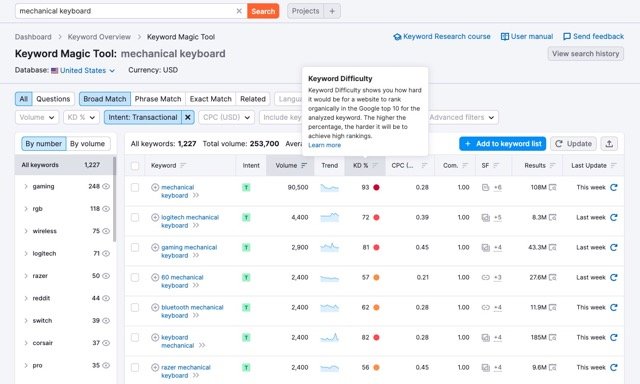
I often use the Semrush Keyword Magic Tool to find related queries and filter the results by search intent, keeping only the transactional ones.
— Semrush (@semrush) June 14, 2022
Pick a few of the best ones according to your usual keyword research criteria.#SEOthread @AlizeeBaudez pic.twitter.com/9ogMu9yiTl
3 - Implement your transactional keywords where it matters the most
Make sure the keywords you end up with are in the page title, the meta description, the headings of the page. Include them in bold in your paragraphs, optimise your copy in the best way possible.
Extra elements to consider on your product page
💡 Extra elements to consider on your product page:
— Semrush (@semrush) June 14, 2022
→ Have a clear CTA for your product
→ Keep the page design simple and effective
→ Go to the point in your copy
→ Include reassurance elements (reviews, payment options, delivery, use cases...)#SEOthread @AlizeeBaudez
If you need any help with your product page, your e-commerce website, or if you want to optimise your keywords for the right search intent, get in touch with me today!
BrightonSEO April 2022 recap, notes and slides
I can’t believe this was my 5th time at BrightonSEO (IRL). I don’t do many conferences, but this one is worthy enough for me to travel 1000+ km twice a year to hang out with fellow SEOs, learn tons, make new friends, and, of course, grab a fish’n’chips on the beach - if the seagulls don’t steal it from me!
I took loads of notes, and plan to catch up on the talks I couldn’t attend on the BrightonSEO video vault. Until then, here are a few excerpts of my notes, as well as useful links and resources.
Quality assurance
Goodbye SEO fuckups! Learn to set a quality assurance framework
Slides and talk by Aleyda Solis.
Notes:
85% of SEOs have one to two major SEO incidents each year
We generally spend more time fixing and improving than building stuff
It’s not only a matter of catching error faster but to prevent them too
SEO monitoring should be a part of a broader SEO quality assurance process:
Educate to prevent SEO mistakes
Validate to avoid launching SEO errors
Monitor
Technical SEO QA: shining a light on invisible work
Slides and talk by Myriam Jessier & Gianna Brachetti-Truskawa.
Always have a staging environment to test things on
Define what’s important for your QA:
Critical pages
User flows
Core functionalities
Questions to ask yourself: Is it crawlable? Is in indexable? Is it rank-worthy?
Make sure to communicate potential risks to the teams
What matters:
Do not overload with thousands of pages
GSC has a time delay, so keep it in mind for QA
Some QA checks must be manual
QA your code: canonicals, schema, and hreflang
Use a configuration file in Screaming Frog, so everyone does QA the same way every time
Be aware that each type of site has its own QA flavour
Some deployments are not done by humans: cron jobs, scripts, server updates
Brand vs SEO: how to win allies and influence brand guardians
Slides and talk by Becky Simms.
Use personas, even when you work on SEO
SEO and the brand both use the website as a vehicle, so there’s necessarily some overlap or collaboration opportunities between both fields
Fundamentals
Beyond the basics: 5 (or 10) Google Business Profile elements you might not know about but REALLY should
Slides and talk by Claire Carlile.
There’s now a “request a quote” feature in Google Business Profile, but it can show how your potential clients can get quotes from your competitors as well
In your local results tracking tools, include your competitors
UTM trackers in URLs are crucial in GBP
When you ask for reviews from your clients, give them ideas on what they could write about to avoid “empty” or boring reviews
Use Vision AI to check what Google sees in the pictures you add to your Google Business Profile. You want to make sure what Google sees reflects what you want your business to show.
Reporting
Freddy Krueger’s guide to scary good reporting
Slides and talk by Greg Gifford.
There’s an unconscious bias where clients don’t always trust digital marketers or SEOs. That means every time we get in touch with our clients we have to overcome the mistrust.
Your client came to you for a problem, and you provide a solution, so the solution needs to appear in the report. Clients want to know quickly if the stuff you do is working.
So the most important thing is to know what to put in your report.
You need to make it crystal clear that what you do matters. This is often as simple as:
Organic traffic
Leads
Organic leads
That’s all you need in the end and that can up be put in one page.
Customise reports to each client to speak to each clients goals. Use questions over jargon for headlines.
Keyword research
How to go after the long tail keywords (and why it matters!)
Slides and talk by Paola Didone.
For long tail keywords, instead of creating new pages for each, start by focusing on pages you already have. You can add a small paragraph on a category page with those long tail keywords and it will do the job for the most part.
Check what is already ranking for the keywords you are targeting
Look at the proportion of the search volume of the head term vs the long tail keywords volume. There’s more point to targeting a long tail keyword that represents 30% of the head search term volume than 0.5%
Effective zero-volume keyword research and why it’s important
Slides and talk by Mark Williams-Cook.
Interestingly, the content ideas AlsoAsked provides will likely have zero search volume.
70-80% of searches are long tail keywords
15% of searches are new
So by not focusing on these keywords, we are actually getting on just 15% of keywords.
It’s not because you have a very low search volume that you shouldn’t write about something. Think about intent volume instead of search volume.
Agency & Freelance SEO
Managing expectations with “impossible keywords”
Slides and talk by Jessica Maloney.
“Impossible keywords” are the ones where the SERP is dominated by a brand (ex. Chapstick) for example, the ones where the client wants to to rank for X without further explanation.
How to proceed with the client:
Understand why
Education
Data : it’s your backup to explain and show the client what’s possible, keyword difficulty metrics
Offer alternative keywords
Use your own data from Google Search Console
Eyes on the competition : when a client comes with a competitor and a keyword, they are often more annoyed by the competitor than by their own ranking for this keyword. So showing them what this competitor does will work better.
Explode your agency growth: be more you
Slides and talk by Nicole Osborn.
Blending in = invisibility
Home page should say :we know what your problems are and we know how to solve them”
Add call to action on the first screen of the home page
Your copy has to be super attractive, honey to a bee
Don’t be too vague on what you do great
Purple and blue themes are overdone
Stock images are boring
About page: have pictures of the people, not the building
Boring won’t get you on the best shortlists 😉
3 strategies to ditch boring:
Stand out brand values
Connect with stories: be noticed by more of your best fit clients, tell people about who you are and they will come
Show your personality
People want to work with people they like, and they will talk about you if they believe they’ve found a rare pearl
Future of Search
Web design for people and planet
Talk by Tom Greenwood.
Check out the Website Carbon Calculator
Practical step to make a website more efficient for everybody and the environment:
Do you actually need this bit of code or this image?
Images weigh way more than a thousand words
For simple stock photo pictures, is it really communicating useful information?
Blurring the edges of a photo where you have a subject in the center can reduce the size by 50%
WEBP files are 30% lighter than jpeg
Use SVG files and optimise them by hand because Illustrator adds extra information
Auto play videos burn through data and are detrimental to the environment and to people who don’t have access to a lot of data
Animated SVG are cool
System fonts are zero waste, like Times New Roman, Courrier New, and Arial
WOFF2 font files are lighter
Reuse styles rather than adding styles to improve CSS
Jquery for forms is heavy
MinimalGA for Google Analytics tracking is lighter than Google Tag Manager
Contextual ads over personalised ads -> example: have sports ad on a sports article
Test on Motorola Moto E6 or similar because that is the average of what users have worldwide
Use dark mode
Search in the Metaverse
Slides and talk by Kara Thurkettle.
Impacts on search:
Search what you see
Use AR
Try on clothes virtually so the user gets more information
Use these technologies to do product demos, people are searching more and more for AR related terms like “see flooring in my room”
The Metaverse changes the user journey, where the SERP becomes a 3D virtual street, or where the information provided to the user is even more personalised
Search intent
How to determine search intent for B2B
Slides and talk by Adriana Stein.
Buyer personas are as important up in B2B in B2C
The challenge for SEOs is to align search intent and purchase intent
B2B is more complicated than B2S in the purchase decision stage because you have multiple people deciding to make the purchase, so we need to understand whether the search intent is B2B or B2C, as well as understand what different buyer personas we will have to deal with.
Step 1: Streamline the buyer personas
It’s impossible to talk to people without knowing who they are
Update buyer personas regularly
Simplify it by categorising the personas
End users - the ones that use the product
Influencers - people who have a voice in the buying process
Decision makers - the ones that decide the purchase
Step 2: Keyword research and clustering
Check keywords by hand and look at what the SERP looks like
Depending on the results you’ll be able to tell if they are B2B or B2C queries
Step 3: Keyword map
Map keywords to each page/type of page
Use multiple keywords to describe one product, by tying it to different use cases, different contexts
One seed keyword, multiple related keywords
Step 4: Create content
Use seed keyword, determine what buying stage this refers to, create title, then h1 and body, repeat with another seed keyword.
This is just a quick summary of some of the talks I attended in person at the event. I haven’t mentioned the keynotes which were both incredible, or the talks I’ll catch up on in the BrightonSEO video vault.
If you want to check out all the slide decks from the event, SiteVisibility has them all listed here.
This is hands-down the best SEO conference I have ever been to, I already have my ticket for October 2022 and even pitched to talk! 🤞
Picture perfect! 📸 Increasing relevant traffic for an independent photographer
In this case study, we delve into Clément Renaut's SEO journey as an independent photographer based in Alsace, France. We addressed critical technical errors, transitioning HTTP images to HTTPS and restructuring the website for enhanced user experience. By aligning content with Clément's services and preferred locations, organic traffic related to weddings and family photography nearly doubled and tripled, respectively, over six months. Local visibility in key areas, such as Strasbourg, significantly improved, resulting in higher average positions and click-through rates. This case study showcases the transformative impact of tailored SEO strategies on driving relevant traffic and enhancing online visibility for independent professionals.
Clément Renaut is an independent photographer based in Alsace, France. His unique personality brings the best out of people in a joyful and fun way. He mainly does wedding photography, individual and family portraits. His area of work is in Alsace-Lorraine regions. Photography is a very competitive industry and Clément made many adjustments to his website through the years.

Where we started
Lack of visibility on keywords important for the business
The top keywords for which the website ranked where focused around topics of secondary importance for the business, such as wedding venues, or general informational content about wedding organisation that was not likely to bring in conversions.
Confusion to where the business operates
The website also ranked for cities far away from where Clément operates. Despite his ability to move around in France for photo shoots, most of his revenue is made in a 150 km area around his home.
A mix of HTTP and HTTPS content
Years of updates to this custom-built website have created errors, especially regarding the location of the images. A hole bunch of them were stored on a HTTP repository, triggering mixed content errors.
Goals of the project
Our first goal was to improve the general health of the website, removing critical technical errors that were seen as a red flag by search engine crawlers. Then we would work on improving relevant organic traffic for the website. That means making sure the keywords we would target were:
In line with what his clients are searching for
Relevant to the photography services Clément offers
Local to his area
What we did
Moving HTTP images to HTTPS
Thankfully, Clément has a background in IT and was able to make all the right changes and redirections super fast.
On another note, there is something deeply satisfying to seeing error numbers go down!
There’s something deeply satisfying when you get that kind of graph @semrush 😁
— Alizée Baudez 💫 (@AlizeeBaudez) October 12, 2021
For context, this client is alone in his business, has no team nor developer. He’s a father of 3 doing his best.
I’m so proud and can’t wait to see the impact this will have for him 🥳 pic.twitter.com/8U6YgIrPl5
Reviewing the website structure
We created content clusters around his services and the locations he often visits for photo shoots. The idea was to make sure users (and bots) could easily understand what he does and where he works with an efficient internal linking strategy.
Improve content with relevant keywords
With the help of an extensive keyword research, we worked on improving the on-page content with keywords that were more relevant to Clément’s audience and aligned with their intents.
The results
Website health
With a few technical adjustments, we were able to drastically improve the website’s overall health and decrease the likelihood of Google bot crawling issues.
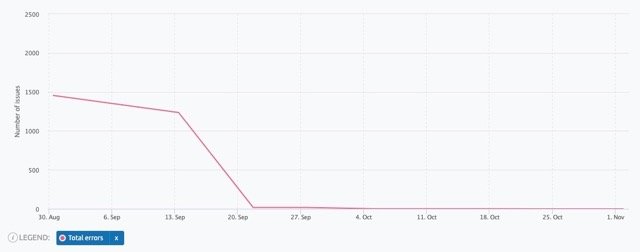
The number of critical technical SEO errors on the website went from 1454 to just 2 in a few days! 🥳

The overall website health improved by 15 points with a few technical adjustments.
Increased organic traffic on relevant keywords
For keywords relevant to Clément’s services, the organic traffic grew substantially over the past 6 months. In the examples below, the focus is on keywords that include “wedding” and “family” which are the biggest sources of revenue for this business.

Organic traffic related to weddings nearly doubled. This could be partly due to the current circumstances, but also to the increased CTR and average position of the website on these queries.

Organic traffic related to families tripled over the past 6 months and the CTR grew by 1 point. The website on those queries also ranked more than 13 places higher than before!
Increased Local organic visibility
When it comes to local organic visibility, the website performed much better. The example below if for keywords including “Strasbourg”, the biggest town in Clément’s area.

For keywords including the location “Strasbourg”, the average position of the website increased by 4 ranks, the CTR increased by 2 points, and the number of clics was doubled.
Client feedback on this project
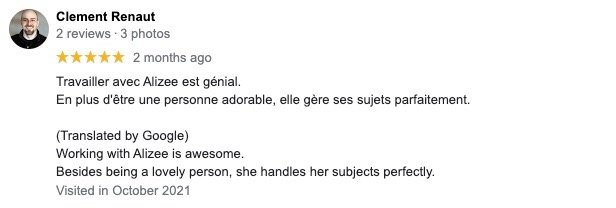
“Working with Alizee is awesome. Besides being a lovely person, she handles her subjects perfectly.”
If you found this case study interesting and would like to enquire about SEO services, you can contact me here:
Teaching a Digital Marketing Class for EM Strasbourg Business School - 2021/2022
In the first semester of 2021/2022, I taught a second-year digital marketing class at EM Strasbourg Business School. The course introduced how websites work, how users behave online, and the core principles of digital strategy. Across five sessions, we explored digital transformation, online consumer psychology, SEO fundamentals, and practical ways to improve user experience and conversions.
I kept the learning hands-on: interactive Slido polls, small-business case studies, and group exercises where students acted as CEOs to define missions, values, and goals. We finished with an introduction to tools like Google Analytics and Search Console to help students understand how websites are measured and improved.
It was my first large in-person class, and students particularly enjoyed working on real businesses and seeing how digital strategy connects with meaningful, human-centred marketing.
In the first semester of the 2021/2022 curriculum, I taught students in their 2nd year (the equivalent of Master 1) Digital Marketing. My focus for this class was to teach students about what digital marketing looks like in 2021 and key concepts they should have in mind when working on a website. It was an introduction course to Digital Marketing focused on websites and their performance. Topics related to social media were covered in another course of the curriculum.
The class was taught in French to 57 students, face to face in Strasbourg, and split in 5 sessions of 2 to 3 hours. The syllabus for this class was pretty ambitious, as I realised session after session. After getting some feedback from students, I'll make sure to lighten some parts of the program so we can focus on the most important concepts.
Digital marketing class outline
Here is the breakdown of chapters we went through for each session.
Session 1 - 3 hours
1. Introduction
2. Culture and digital transformation
3. The online consumer
Session 2 - 3 hours
4. Digital marketing strategy and instruments
Session 3 - 3 hours
5. Visibility on search engines
Session 4 - 2 hours
6. User experience and conversion rate optimisation
Session 5 - 2 hours
7. Measuring and analysing data
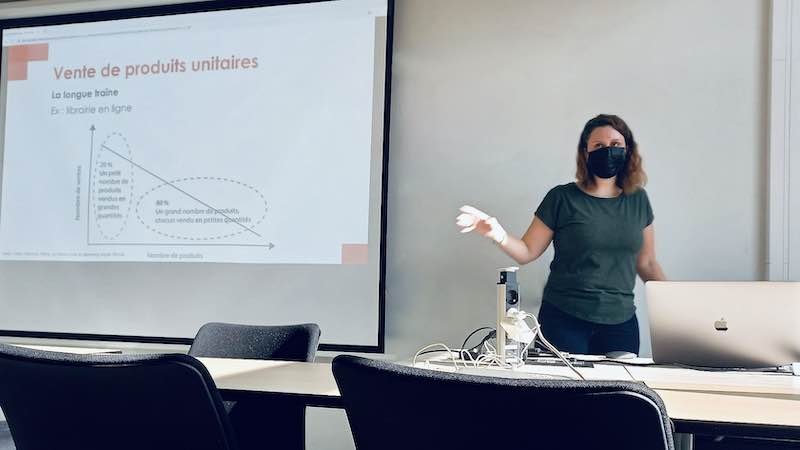
Alizée Baudez teaching a class in digital marketing
Teaching in action! ;) Thanks Imane for the picture :)
The DIGITAL marketing class in detail
Now, let's go into detail about what we explored in each chapter and some of the activities we did in class and examples of what students created.
1. introduction
This section was pretty straight forward, I basically explained who I am, what I do and explained the functioning of the class.
I also needed to understand who my students were. I could have spent 30 minutes asking each one of the 57 students to present themselves, but that would have been extra boring. So I used a service called Slido to have an interactive set of questions they could answer and see the results live. Students just had to scan a QR code to access the polls.
For example, the first question was "Why did you choose to study Digital Marketing?"
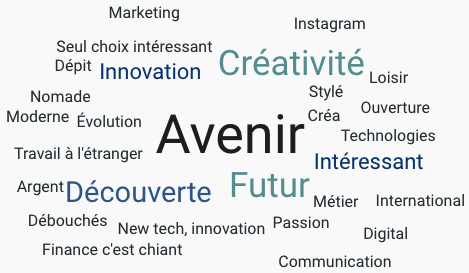
Answers (in French) from students to the question "Why did you choose to study Digital Marketing?"
If you don't speak French, here are the main keywords that students came up with for this question:
Future
Creativity
Discovery
Interesting
Innovation
...and the notable "finance is boring" 😂
2. CUlture and digital transformation
In this chapter, I presented where French companies are at with their digital transformation. I think it's pretty easy to think all companies nationwide are 100% digital, especially after the pandemic. But the reality is that we only see the companies that are already well advanced on their "digital" journey. The ones that are still in the process of becoming "digital" are not yet visible online to most people.
Then we went through the main business models for online businesses. From e-commerce to affiliation, from content creation to subscriptions. I also spent some time explaining cases of co-creation, specifically through examples of Katnipp and XXLScrunchie, a British stationery company and a Canadian accessories company. Both document their business journeys on YouTube and co-create their next collections with their communities.
As a rule of thumb, most of the examples and case studies I use in my classes are about small businesses. The vast majority of the French workforce work for small and medium-sized businesses, and I believe it brings more value to students to study businesses with relatable people behind them.
The last part of this chapter was dedicated to ethics on the web. I found it important to explain to students the impact of online activities on the environment, but also and especially the impact it has on our societies. Most students had never heard of micro-jobs and micro-tasks, the psychological difficulties experienced by Facebook moderators or the ways Amazon’s Mechanical Turk and Google’s Task Mate tend to exploit minorities with highly underpaid assignments.
3. The online consumer
This chapter focused on understanding how the online costumer journey differed from the traditional customer journey. But as we all know, humans are not rational beings and we are all prone to cognitive biases.
So I then explained what cognitive biases are, with a few examples of how they impact our day to day lives, and, of course, how they impact the online consumer. Understanding cognitive biases and more generally how our brains function when we browse, can heavily impact the way we conceive and optimise websites.
It might sound counterintuitive to talk about psychology and neurology in a digital marketing class. As a freelance digital marketing specialist, I think I do a better job at optimising websites now that I know about cognitive biases and how the brain works.
4. Digital marketing strategy and instruments
This chapter focuses on digital marketing strategy and the instruments of digital marketing.
I explained what a digital marketing strategy is through 2 concepts:
Defining a company’s mission, its vision, its values and finally drafting an elevator pitch ;
Using Simon Sinek’s Golden Circle by defining the what, the how and the why of a company, and then using this framework to create a pitch and define goals.
I also touched on the difference between owned, earned and paid media, the importance of having your own website, and not just relying on social media.
Class activity : What if you became a CEO?
Digital marketing strategy can be quite tricky to grasp as a concept. So I asked my students to form groups of 4/5 students, and assigned them randomly a company they would pretend to be CEO of.
The companies came from a list of fellow entrepreneurs that I appreciate, all small businesses. Students were then able to send their findings to these entrepreneurs and have the opportunity to actually help someone out. As a small business, its always highly valuable to get insights from an external point of view!
I asked students to follow these steps:
Familiarise themselves with the companies they were assigned to
Find their mission as a company
Uncover their vision for the company
Determine their company’s values
Define their Golden Circle
Use these elements to create and present their elevator pitch
Define their digital marketing goals for the next 6 months
Explain how their digital strategy would pan out for the next 6 months to meet their goals
Feedback from students on this activity was pretty positive. They were happy to work on relatable businesses and to go through the essential steps to create a digital marketing strategy by themselves.
As you can see, I chose to focus more on the internal motivations of an entrepreneur than on just defining goals. As an entrepreneur myself, I find that effective goals and strategies come from within, from a place of deep self reflection. This process also tends to avoid focusing on vanity metrics and unsustainable goals that solely come from comparing a business with another. It’s also applicable on a personal level, which I thought could be useful to students finding their path in life.
5. Visibility on search engines
This chapter is dedicated to Google Search and it algorithm. As an introduction, I re-used Slido and asked students to tell me in a few words what they know of Google.

Answers (in French) from students to the question “What do you know of Google?"
Interestingly, their results were a good mix between Google products, and issues around data privacy.
For this chapter, the idea is to take students from a place where “Google is magic” to a place where they understand how the Google Search algorithm functions and where results for a query come from. Through this part, I touched on the following points:
A brief history of Google
The main Google Search updates
The Search Engine Result Page (SERP)
The position zero
The Knowledge Graph
The fold
Search operators
How the Google Search algorithm works
Ranking factors of the crawler, the indexer and the ranker parts of the algorithm
This whole section of the digital marketing class is not about the small updates Google Search does every day or so, it’s about the long term vision of Google. Understanding where the algorithm comes from, what it’s been through and how the search landscape evolved through time helps us better understand where it’s going. That way, we avoid unsustainable FOMO*-induced decisions. *Fear Of Missing Out
Since I’m specialised in SEO, I primarily focused on Google Search, and only scratched the surface of Google Ads.
6. User experience and conversion rate optimisation
In this chapter, I started by explaining some additional concepts complementary to the online customer journey: the ZMOT (Zero Moment Of Truth) and the difference between inbound and outbound marketing.
Once those concepts were understood, I moved on to conversion rate optimisation, based on “Making Websites Win” by Dr Karl Blank and Ben Jesson. The conversion rate optimisation methodology they use is a sustainable way to improve websites based on data rather than pure intuition, taking advantage of the benefits of A/B testing, amongst other tools. I exposed to students the founding principles of this methodology:
Design for function, not aesthetics
Test, always test
Make frequent, incremental changes rather than full websites redesigns
Class activity : The diagnostic, problem and solution methodology to optimise a website
To help students better understand how to optimise a website, I asked them to form groups of 4/5, and assigned each group the website of a small business.
For this class activity also, I asked students to work on the websites of small businesses, that could really make use of an external outlook on their business.
For the conversion rate optimisation activity, I asked students to follow these steps:
Familiarise themselves with the website, go through the conversion funnel as a potential customer would. For this particular step, students had to find to goal of the website (or the most important goal of the website form a business standpoint) and where the conversion happened for this goal.
Diagnostic: because the class activity could only last 1 hour, the diagnostic was the same for all websites. In this case, all websites were said to be receiving enough trafic, but the conversion rate was not satisfactory.
Problem and solution: students had to identify problems that could prevent conversions, and offer potential solutions to each problem they found.
Describe a couple of A/B tests the business could do.
Although this activity only lasted 1 hour, students came up with amazing ideas. They sent me some of them and I shared them to the entrepreneurs. You’ll find below a few screenshots of my students’ work. Keep in mind this was done under an hour by people who hadn’t heard about conversion rate optimisations before.
Tchungle.com

A/B test ideas from students for Tchungle, a plant shop in Strasbourg

A/B test ideas from students for Tiny Sarah's Cakes, a vegan cake maker in the UK
I found there’s a real sense of pride for students to get to know an entrepreneur through their work, and to come up with ideas and propositions that can actually make a difference to someone, maybe even to their whole family. In my opinion, this brings way more value and understanding than doing yet another essay on a huge brand that no one will read.
7. Measuring and analysing data
The final part of this digital marketing class was focused on demos of Google Analytics, Google Search Console and Google Tag Manager. The idea is for students to grasp the utility of each tool and get to know what they are about.
In an introduction class like this one, and given the ambitious program we had to get through, I don’t think there’s much point in teaching them all the ins and outs of these tools. Most of these students will specialise in Master 2 in digital marketing, and they’ll get the chance to handle these tools then. At least, leaving my class, they’ll know what these tools are about and why they are used for websites.
In conclusion
My overall experience teaching this class was very positive. It was my first class taught in person, and the first time I had so many students.
Students haven't yet given their evaluation of the class, they should be able to give their feedback at the end of the semester. But I did get feedback from them live and by email. Here are a few testimonials I gathered.
I want to thank you for the exciting class this morning!
Imane - EM Strasbourg Business School - 2021/2022
I particularly enjoyed your teaching and the references and companies we worked on for the case studies.
Mathilde - EM Strasbourg Business School - 2021/2022
Enquire about teaching digital marketing
Learn more about other classes I teach
If you would like more information on the classes I teach both online and in-person, get a copy of some slides for this class or simply enquire about teaching at your school, you can fill in my contact form and I'll get back to you ASAP :)
Content repurposing: recycle content you already have!
I published a class on content repurposing!
I have been working on two new projects lately, that work hand in hand. The first is a podcast about digital nomads, a topic I have been passionate about for the past five years. You can find detail about it here. The second one is teaching online. I am a firm believer that education and information are the most important things the internet has brought to the world and I wanted to participate in that.
Get access to the course on content repurposing and 2 months of Skillshare for free!
A couple of months ago, I was contacted by the Skillshare teaching team to collaborate to the platform as a teacher. I have experience in teaching IRL, but I hadn’t tried online teaching yet. I figured it was finally time for me to give it a go.
As it turned out, the launch of my podcast implied working with new methods: I learned (and I am still learning) to record audio, edit it, and publish it. I relied on Skillshare to learn these new skills and thus, already knew quite well the platform. I also got to use skills I hadn’t practised in some time like creating a brand from scratch, creating videos for social media, growing an audience on Instagram, building a community, creating a website from scratch and optimising it the way I intended, and using the content I had created to its maximum potential.
That’s where content repurposing comes in. I listened and studied hours of podcasts to understand how others were using recorded audio to their advantage. One huge inspiration was, of course, Gary Vaynerchuk, who mastered the subject long ago. I then created a complete process, that gets improved episode after episode, to create tens of pieces of content from one long podcast episode, easily shareable on social media and built for engagement.
During the process, I spoke to a few people about my content strategy and looked in depth at what other podcasters were doing. I found out most people didn’t know about content repurposing or didn’t use it. Most of the content is published once and advertised once, but not used to its maximum potential. That’s when I started working on the class.
Since I wanted to try teaching online, I decided to create a first class on content repurposing. The course is aimed at people who want to try content repurposing but don’t know where to start, marketers or business owners who have long-form content already published that wish to make the most out of it.
The class is short and concise — 15 minutes long, with many practical examples from my own experience with this method. It is focused on using long-form content to create multiple smaller ones. I plan on creating another class about creating long-form content from different small ones. More on that later :)
The class is only accessible to premium users, but by following this link, you will get 2 months for free. You can cancel at any time :)
👉 Get free access to the class
If you think this post can help a fellow human grow on the internet, make sure to share it!